Lucky Nail Colors: Birthday, Zodiac and Good-Luck Manicure Ideas
Lucky nail colors for 2027: the Fire Goat year (丁未) begins on February 6, 2027, and its shared reference colors are warm reds with oat and ivory neutrals. On nails, try one carmine #960018 accent with warm ivory #E8DBC5 and deep green #344737, or pick one of the three layouts below: rose #D7AAAE, muted green #718675 or cherry #9E3446. By birth year, start from your zodiac animal’s palette in the 2027 zodiac color guide; for today, open the daily color card. These are styling references, not a promise of luck.
Lucky nails are a personal styling ritual: choose a color to represent an intention, then make it work for your nail length, clothes and appointment. Birthday nails, zodiac nails and manifestation nails can inspire a design; they do not establish that polish changes luck, money or relationships. EssaColor combines birthday-based cultural inspiration with practical nail palettes.
Choose one layout, then confirm swatches and execution
A love intention: rose, cream and plum
Original editorial screen palette: rose #D7AAAE, cream #F1DED0, plum #A28095. Thumb to pinky: rose, cream, rose, cream, rose; add one plum dot to the ring finger. Short nails: omit the dot and keep two solids. With a cream outfit, rose stays soft; with navy, it becomes a clearer contrast. Treat love as your chosen theme rather than a promise to attract someone.
An abundance intention: green, oat and gold
Original editorial screen palette: muted green #718675, oat #E8DEC9, gold #B99A62. Thumb to pinky: green, green, oat, oat, green; one fine gold line on the ring finger. For work or short nails, use oat on four fingers and one green accent. Gold is a decorative color direction, not a guaranteed money-attracting material or an exact polish match.
A confidence intention: cherry, blush and ink
Original editorial screen palette: cherry #9E3446, blush #E8CBD2, ink #293346. Thumb to pinky: cherry, cherry, blush, blush, cherry; an optional tiny ink dot on one blush nail. Prefer a quieter set? Swap three cherry nails for blush. This is a statement manicure you choose for yourself, not a test of attraction or the red nail theory.
Copy this after choosing your layout
What does “lucky nail color” mean?
People use the phrase for different things: a birthday-inspired color, zodiac nail art, a cultural good-luck symbol or a reminder of an intention. Choose the meaning first. A birthday celebration can use a favorite color; a monthly reset can repeat one small motif; a date can use a palette that makes getting ready feel more personal. There is no universal lucky-color chart shared by all traditions.
Birthday nails, zodiac nails and Five Elements are different routes
Birthday nails can simply mean a manicure for your birthday party. Western zodiac nail colors use an astrological styling theme. Chinese Five Elements color inspiration uses a different cultural framework; its wood, fire, earth, metal and water categories are not the Western four elements. Do not substitute one system’s color list for another or infer a detailed birth chart from a generic sign. EssaColor’s result is styling inspiration, not a prediction or a full compatibility reading.
From a birthday palette to a salon brief
In EssaColor, choose the birthday, target month and available wish that fit your inspiration; review the generated palettes rather than assuming they match the editorial examples above. Pick a main color, a neutral and an optional accent. Tell your artist your actual nail length, finish and finger placement; compare physical swatches in daylight and indoor light. HEX values communicate screen direction and cannot identify a branded polish.
What to ask for when saving a reference image
Save the shape, main-color balance, accent position and finish separately. A long almond reference can become short squoval nails by keeping the colors and dropping dense marble or raised details. Do not ask an artist to reproduce a hidden thumb from a partly cropped reference. Start with one repeatable accent, then confirm what the chosen materials can achieve.
Continue with your occasion
Birthday and lucky nail colors · Date night prep checklist · Date nail palettes and reference images · Skin tone and physical swatches
Common questions
Which nail color brings good luck?
There is no verified universal lucky nail color. Choose a symbolic meaning you enjoy, then test the actual color beside your hand.
Can I choose lucky nail colors by birthday?
Yes, as a personal or cultural styling theme. Different systems give different suggestions; a birthday-based palette is not evidence of future luck.
What is today’s lucky nail color?
Open EssaColor’s daily color card. It shows today’s shared outfit palette, updated daily; add your birth date, birth period and city to see your own colors for today, with no sign-in. Use its main color on one or two accent nails. It is a cultural styling reference, not a prediction.
What are lucky nail colors by birth year?
Find your Chinese zodiac animal from your birth year; the animal year changes at Chinese New Year, not on January 1. Then start from that animal’s element palette in the 2027 zodiac color guide: Tiger and Rabbit (Wood) bamboo green #3A5737, ivory #F6F0DD, brick red #964B43; Snake and Horse (Fire) cinnabar red #B67260, pearl white #EDE5D1, ink blue #2D3B52; Ox, Dragon, Goat and Dog (Earth) oat #BFB299, ivory #F6F0DD, pine green #548568; Monkey and Rooster (Metal) silver gray #B3B5B9, mist blue #9CB7D5, beige #E8DCC7; Rat and Pig (Water) navy #34445F, pearl white #EDE5D1, cinnabar red #B67260.
Are zodiac nails the same as Five Elements nails?
No. Western zodiac themes and Chinese Five Elements are different frameworks. Use one as inspiration without mixing their rules into a prediction.
Can I wear red nails for a date?
Yes, if you enjoy red. Red nail theory is a beauty-trend phrase, not a reliable way to predict attraction. Choose the finish and contrast you want.
Create your nail color palette
Aura and blush nails: centered, off-center or tip gradient?
Aura here names a soft halo layout, not an energy measurement, personality assessment or luck-changing technique. A favorite color can be an intention theme while precise placement describes the design. These original diagrams hold nude-apricot #E9D8D0 and rose #A95F7C constant; intermediate colors are digital blends, not a request for a third polish bottle.
Centered aura: leave the base around it
Rose diffuses outward from the center rather than forming a hard outline. Confirm the center shade, spread and whether the surrounding base remains visible.
Off-center halo: specify placement
Move the center toward one side and specify the direction for each hand. A camera angle can make centered art look off-center; mark the intended location with an arrow.
Tip gradient: blend along the length
Color fades from the free edge toward the cuticle, instead of radiating from the middle. Specify white tips separately if wanted; Aura or Ombré alone does not define the colors.
How should it work on short nails and across five fingers?
Compare one sample at your actual length: can you see the center, does the base remain around it, and is the transition soft rather than a hard dot? A starter layout keeps thumb, index and pinky solid nude-apricot, with centered halos on middle and ring. Repeat on both hands. On a small plate, keep only ring as the halo accent instead of shrinking multiple halos, stars and letters into the space.
Connect the outfit and intention without promising effects
Cream clothing can leave the rose center as a soft focus; navy can contrast with the pale base. You can give the set a personal intention name without claiming it attracts a person, changes income or reveals an aura. If you prefer a darker base, compare a physical base sample before choosing the center; do not infer mixing ratios from the screen gradient.
What should you confirm when booking?
Specify a soft diffusion rather than a hard-edged dot; mark centered or off-center placement, the accent fingers and the visible base around it. Ask which materials and method the artist proposes and request a sample at your actual length. A photo alone cannot identify lacquer, gel or another technique; these maps do not prescribe airbrushing equipment, curing or coat counts.
“Keep my current short length and nude-apricot base. Use softly diffused rose centers on middle and ring of both hands, with solids elsewhere. Keep base visible around each halo; no hard circles or magnetic bands. Show one sample before proceeding. If space is limited, keep only ring. Confirm physical swatches, method, time and price.”
EssaColor provides palette and style inspiration; these digital maps do not predict physical blending, a skin-tone try-on or fortune.
Complete and download your brief · Distinguish halos from magnetic bands
Terminology context, not search-frequency evidence: Manucurist: gradient and aura nails. Layout maps, colors and finger plans here are original.
How can an intention palette become a nail layout? Compare two-color blocks
Use a favorite color as a personal reminder if you wish; its proportions do not change fortune or relationships. These original maps keep slate green #617E7B and cream #EAE0D2 fixed while comparing direction and area within a nail. They are not physical swatches.
Vertical split: two accent nails
Use roughly half slate and half cream on middle and ring, with slate solids elsewhere. Specify the light side and whether the hands mirror.
Diagonal corner: same colors, less area
Put cream in one corner of middle and ring, leaving slate elsewhere. On short nails, use one accent corner; do not automatically turn it into a French tip.
One split accent: reduce complexity
Only ring is split; middle returns to solid slate. Keep everything else the same. Compare this option first with multicolor or busy patterned clothes.
Choose area before short-nail and outfit details
Check one sample at your actual length for the boundary and balance. Reduce accent count on small nails instead of adding length, fine outlines or a third color. Compare beside cream, gray or navy clothing and echo just one color if desired. With a busy print, choose one split accent or all slate. Two painted blocks are not clear negative space, and cream is not an unpainted surface.
A color-block salon brief
“Keep my real short length and shape. Use slate as main and cream as support, with physical swatches first. Thumb, index and pinky stay solid; middle is [vertical split/diagonal/solid], ring [vertical split/diagonal]. The light area is [left/right/one tip corner]; the other hand is [mirrored/same direction]. No clear gaps, third color or metallic outlines by default. Check sample proportions and reduce to one accent if needed. Confirm materials, total and time separately.”
Record both hands in the salon card · Adjust the main/supporting finger proportions
Graduation nails: balance school colors, the gown and diploma photos
Treat a graduation palette as a personal keepsake, not a promise about grades, work or luck. Check any explicit ceremony requirements and your actual gown and stole before choosing school-color accents or an everyday palette. These three original five-finger maps are starting points, not official school colors or physical swatches. Graduation is not assumed to occur only in spring or summer.
Echo the gown with one accent
Navy #263C59 on ring only, cream #EAE0D2 elsewhere. Compare beside your actual gown and stole; this navy is not an official school-color match.
Split two stole colors across two nails
Navy on middle, ochre-gold #B99A62 on ring, cream elsewhere. Ochre is flat color, not metallic powder by default. With a busy stole, return to one accent.
Keep wearing it after the ceremony
Pale rose #D9B9B8 on all five nails, checked beside the ceremony outfit and everyday clothes. A graduation theme does not require a year, crest or lettering.
Check the actual photo context once
- Compare physical samples with the gown, stole and clothes underneath. A black gown does not require black nails, and a white outfit does not require white nails.
- At your actual length, hold a blank card naturally and see how much of the thumbs and other fingers appears. Do not place accents solely from a flat-hand manicure photo.
- If you want a year or letters, confirm readable direction, actual size and technique. Omit lettering that will not fit short nails instead of extending by default.
- Compare again with clothes for the meal or work afterward. One accent can be enough for a school-color keepsake; confirm samples, materials and appointment scope with the artist.
Short-nail and two-hand salon brief
“Keep my actual short length and shape, without extensions. Choose [one school-color accent/two stole-color accents/all pale rose], checked with physical swatches beside the gown; an exact official color match is not required. Left/right placements are [specify], with solids elsewhere. No year, crest, chrome powder or raised decoration by default. Omit lettering if it does not fit. Confirm readable direction, sample, materials, total and time first. The palette is a graduation keepsake.”
Label the direction of years or letters · Record physical swatches · Make the two-hand salon card
Brand evidence of the occasion, not search popularity, a product recommendation or a result guarantee: OPI graduation nails
Cloud nails at short length: separate motifs, haze or cloud-shaped tips?
“Soft cloud nails” can mean a clear little motif, a diffused patch or a scalloped tip. Describe the boundary you want before comparing blue-and-white samples. Clouds can be a personal theme of lightness or calm, without promises about luck or emotional outcomes.
| Choice | Boundary to confirm | Both-hand plan |
|---|---|---|
| A separate small cloud | A recognizable rounded upper outline and lower edge, with sky base around it. | One ring cloud per hand:2 patterned nails total. Do not automatically add stars,rainbows and raindrops. |
| Soft cloud haze | A soft color area without requiring a complete outline; not necessarily a cartoon cloud. | One ring patch per hand:2 patterned nails total. Approve the visible base and soft-edge area first. |
| A cloud-shaped tip | A scalloped cloud boundary touching the free edge rather than a floating central motif. | Middle and ring tips on each hand:4 patterned nails total, with solids elsewhere. |
Three original five-finger maps
Hold mist blue #A9B9D6 and cream #F8F3EA constant. Rows run thumb to pinky, with tip above and cuticle below. Maps compare placement and boundaries only: translucent shapes mark a soft-edge region without simulating physical diffusion,coverage,finish or size. Choose among these plans rather than stack them together.
A separate small cloud
Soft cloud haze
A cloud-shaped tip
On short nails, choose recognition or softness first
For a recognizable cloud, keep one complete motif and simplify lobes and extra dots rather than compress several long-nail clouds onto a short nail. For haze, accept an incomplete outline but compare how much base stays visible. If a cloud tip covers too much of a short nail, reduce its area or return to one floating cloud without automatically adding length. Let the artist confirm feasible edges and products with an actual sample.
Outfit and personal-theme colors: echo one element
With a white shirt, a mist-blue cloud set can echo just the white. If clothing already has clouds or florals, compare2 accents with solids elsewhere. Friends can share a base while choosing clear clouds or haze as independent sets. A birthday note such as “take things lightly” is your own theme, not a personality inference or promised result.
Four checks before production
- Motif or color area: specify a complete cloud outline,haze patch or cloud-shaped tip.
- Placement and count: name fingers on each hand,free-edge contact and total patterned nails.
- Real short-length sample: compare boundaries,visible base and actual products without identifying technique from a photo.
- Fallback and quote: use solids if crowded or unsuitable; agree on omissions,time and cost first.
Booking brief: “Keep short mist-blue nails with one cream cloud on each ring,2 patterned nails total. I want a recognizable outline and base around it, without full-nail haze,cloud tips,stars or raised charms. Test at my real length; if crowded,simplify lobes or ask before using solids. Confirm products,cost and time.”
EssaColor supplies screen colors and original discussion maps, without predicting physical diffusion or prescribing universal solvents,curing or mixing recipes.
Write and back up a ten-finger brief · Compare centered aura layouts · Compare short-nail tip proportions · Pick outfit-photo color directions
Cloud motif context,not popularity evidence; these layouts are independently original: OPI: cloud nail art · Maniology: French Cloudscape collection listing
Mythical-creature nails: a whole creature or a motif? Five short-nail adaptations
“Dragon nails” might mean a green palette, scales or a complete dragon. These are different design scopes. We read five existing authorized EssaColor AI inspiration posters as visible nail details plus separately chosen short-nail plans, without automatically transferring background creatures onto the nails.
These are not customer photographs, physical nail products or technique verification. Metallic, stone-like, bright-band and raised-looking details are appearances to discuss. Theme names follow this poster collection rather than establish a universal traditional palette. Birthday, element and wish labels promise no wealth, protection, emotional or relationship outcome.
Qinglong theme: scales rather than a whole dragon
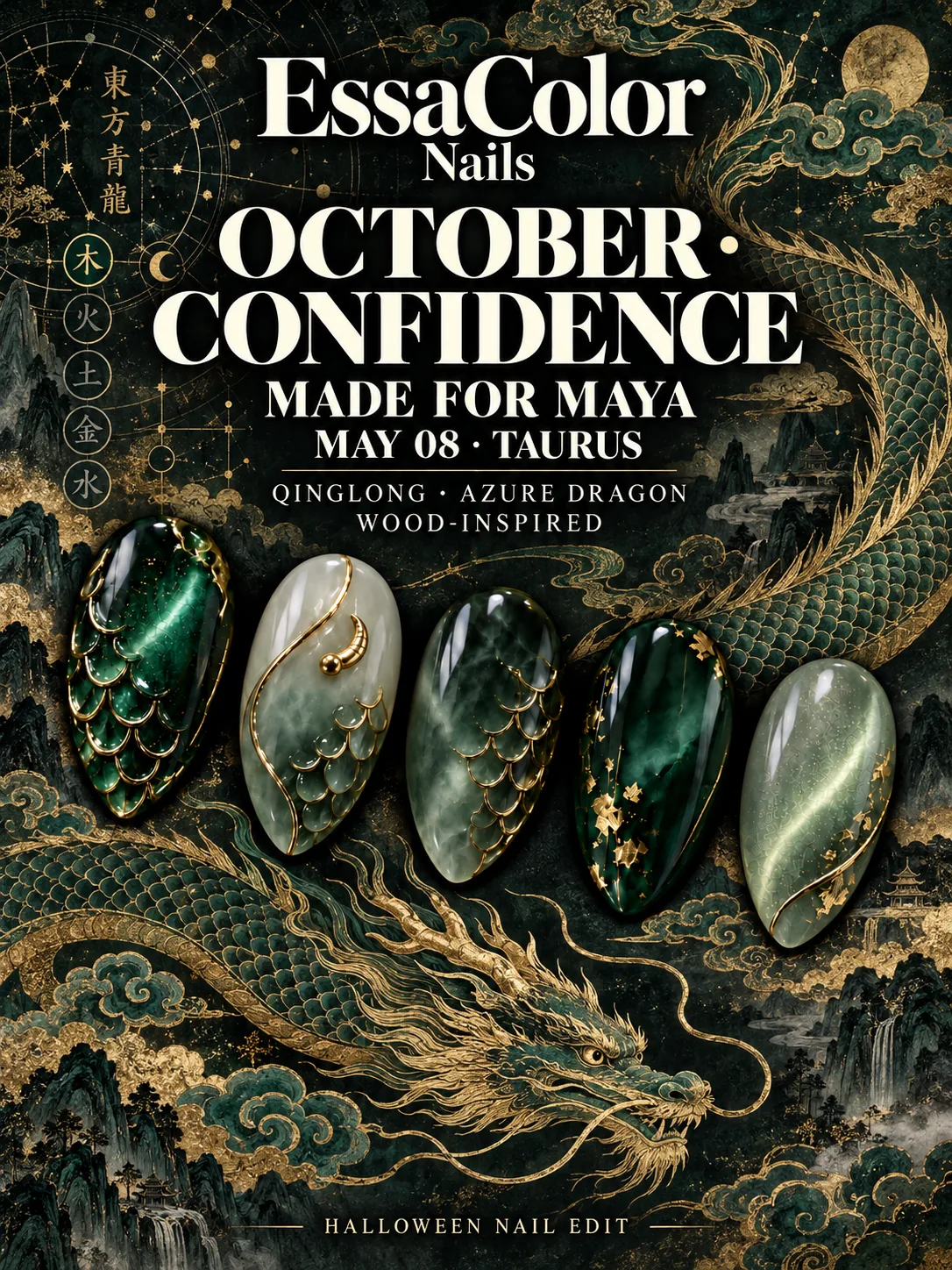
Visible nail details: Visible tips combine deep jade green, pale green/cream stone-like areas and gold-colored scallops or curves. The complete dragon head and body in the setting are not already painted on the tips.
Separate short-nail plan: Use two rows of scallops on a pale ring nail, with solid deep green elsewhere. Do not compress a head, scales, stone pattern and studs into one short nail.
Independently chosen screen directions: #244D3C / #D9E0CF; not calibrated samples or branded polish IDs.
Zhuque theme: a feather spine and a few branches
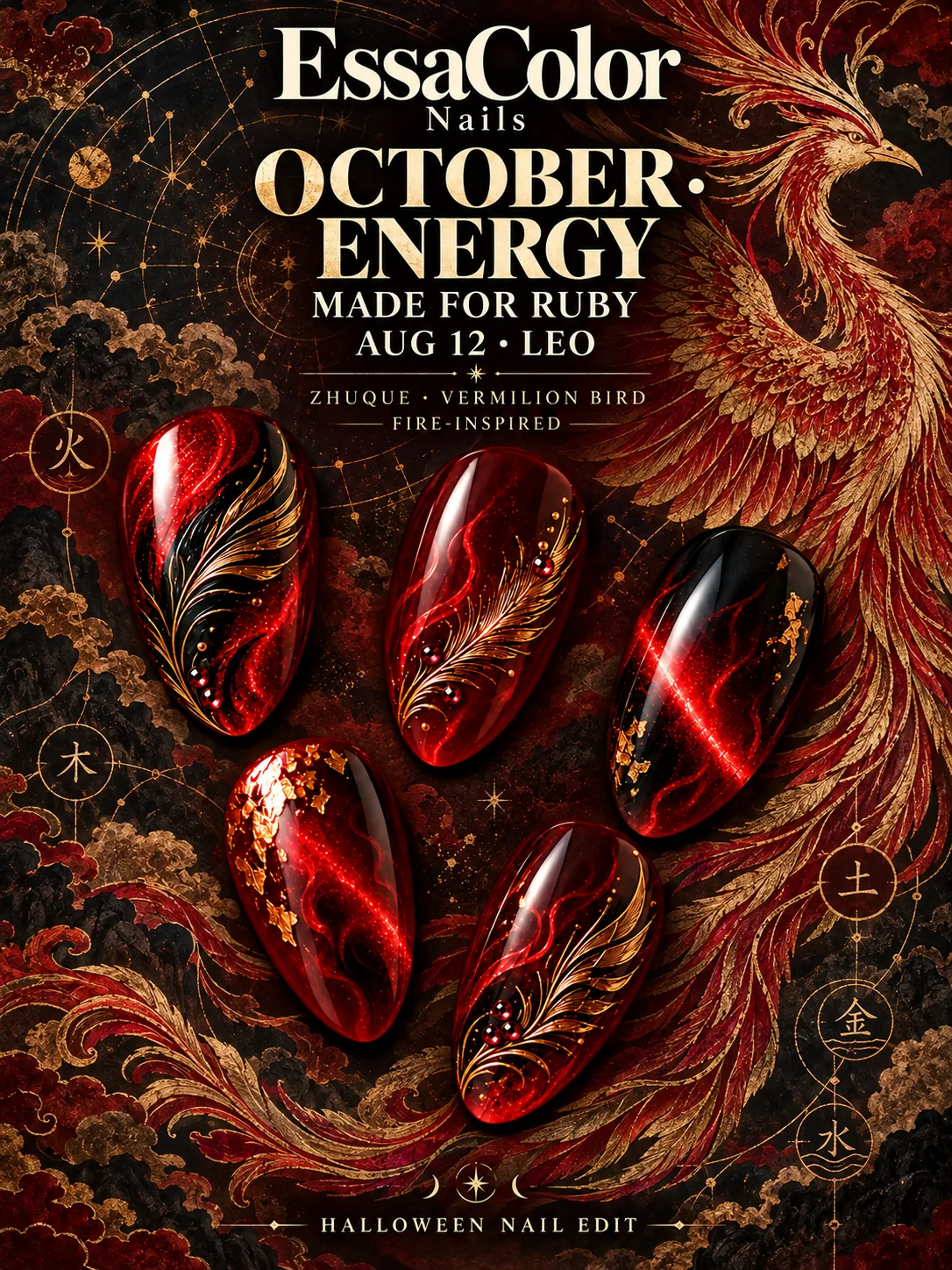
Visible nail details: Visible tips use red/black with gold-colored feather lines, bright bands and dots. The background bird’s head and wings do not all appear on the nails. A feather alone cannot identify a particular mythical bird.
Separate short-nail plan: Keep one spine and three pairs of branches on ring, with solid deep red elsewhere. Omit the light band, studs and full bird first.
Independently chosen screen directions: #8B1D30 / #291D25; not calibrated samples or branded polish IDs.
Baihu theme: irregular short stripes
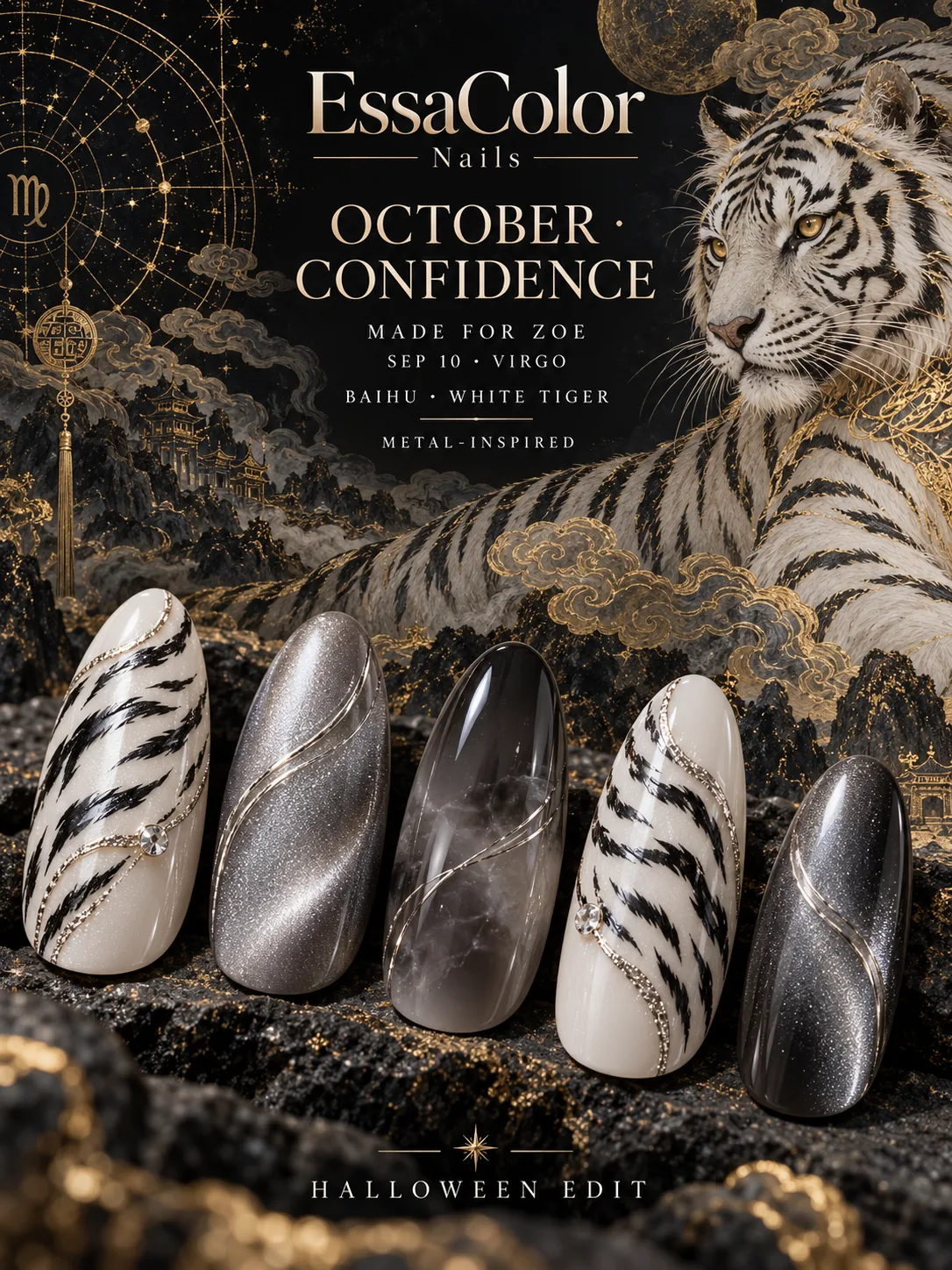
Visible nail details: Cream tips with black stripes, silver-gray reflective areas and smoky dark tips share the reference. Those stripes do not mean printing the background tiger face.
Separate short-nail plan: Use three staggered dark marks on cream ring nails, with smoky gray solids elsewhere. Omit stones, metallic edging and bright silver bands first.
Independently chosen screen directions: #6D6B70 / #F1ECE1; not calibrated samples or branded polish IDs.
Xuanwu theme: a few connected shell cells
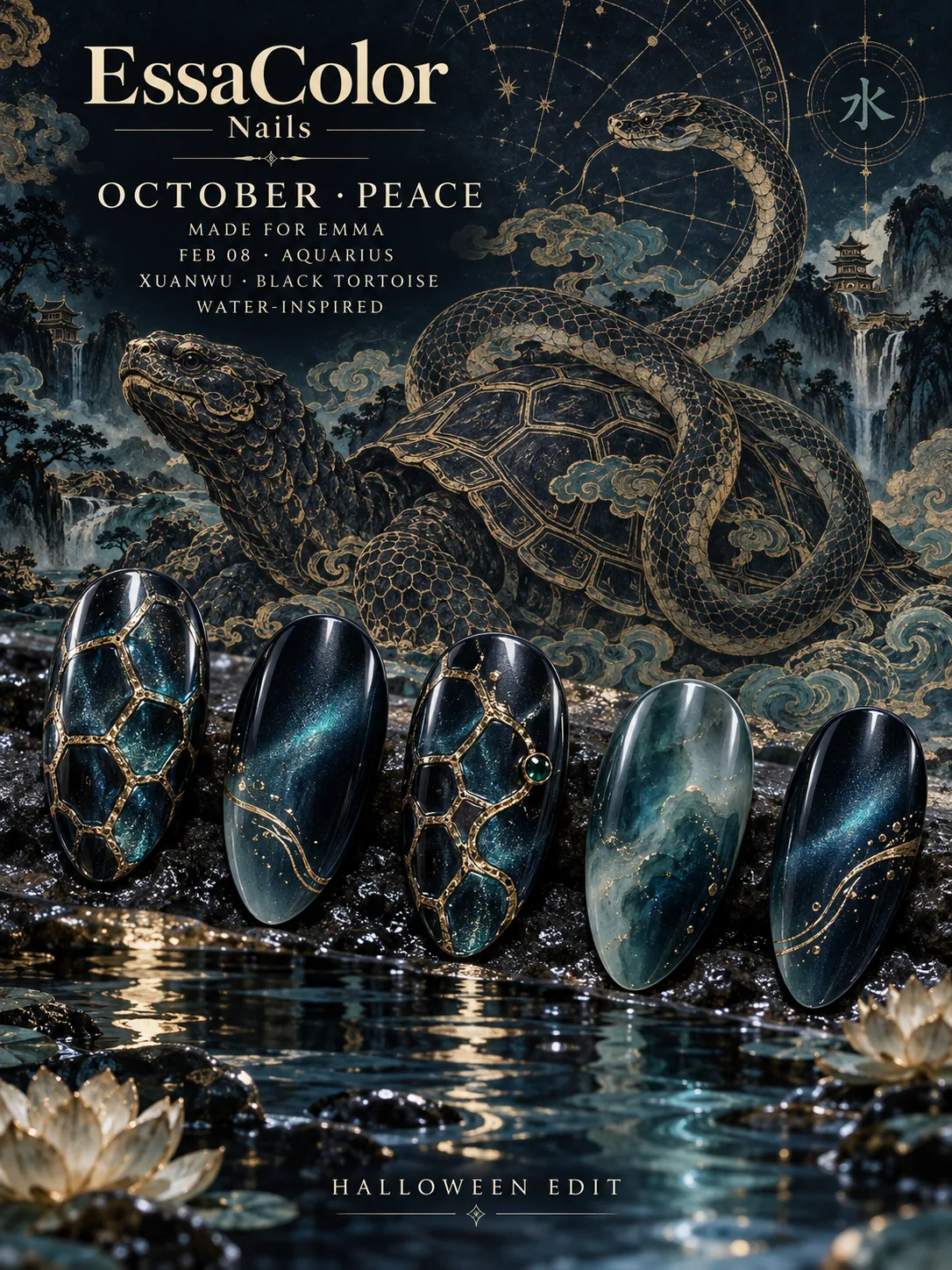
Visible nail details: Visible tips combine midnight blue/teal, paler stone-like patches and gold-colored polygon boundaries. The tortoise-and-snake setting need not appear on every nail.
Separate short-nail plan: Keep one central cell and two neighboring edge segments on ring, with deep-blue solids elsewhere. Do not miniaturize the entire dense grid.
Independently chosen screen directions: #173A49 / #6E9797; not calibrated samples or branded polish IDs.
Qilin theme: scallops or just the palette
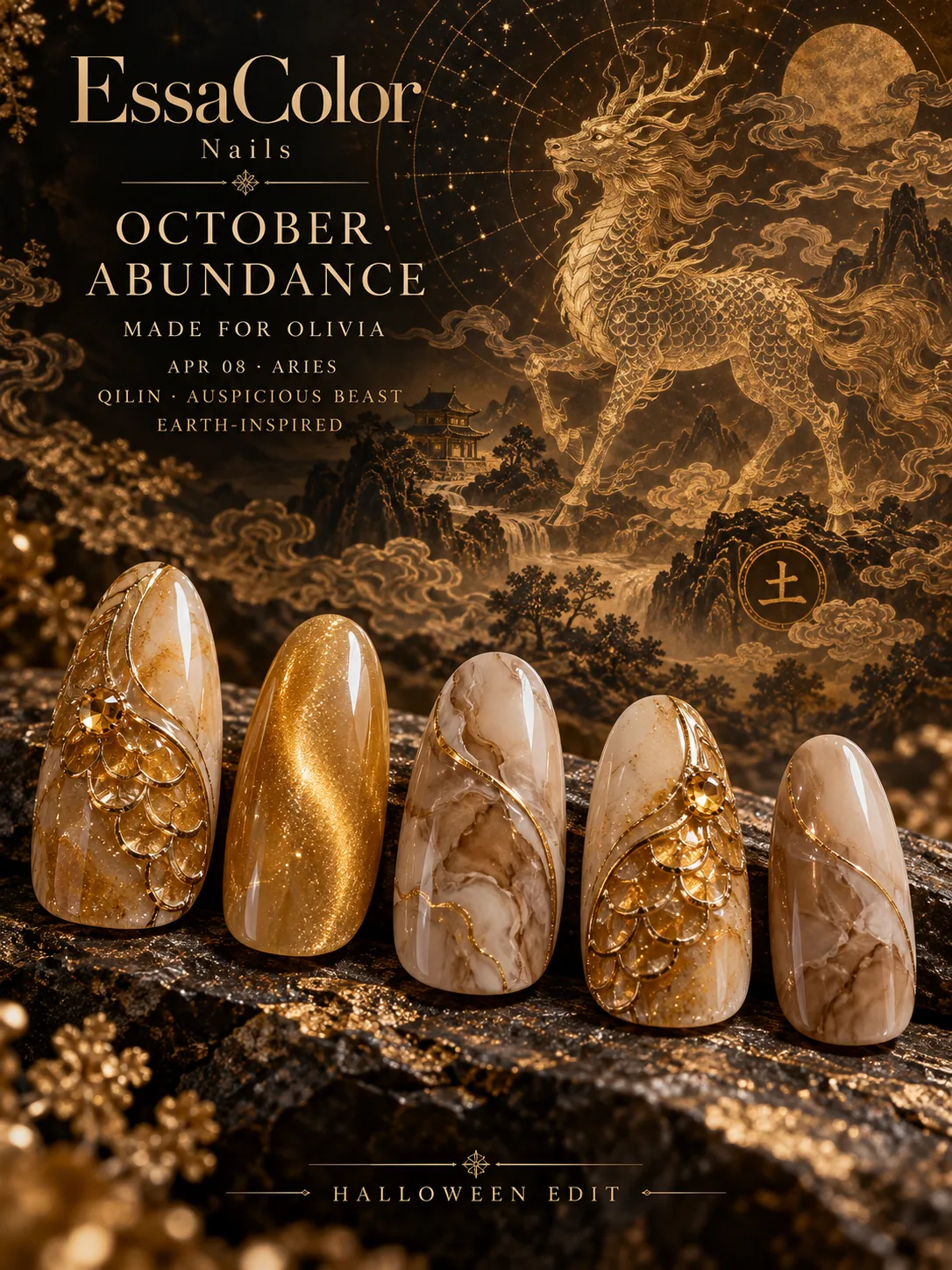
Visible nail details: Visible tips include gold, cream/nude stone-like areas, scallops and raised-looking highlights. A whole creature in the setting and scale patterns on a tip are different requests. The image cannot verify physical height.
Separate short-nail plan: Keep one scallop row on a cream ring with taupe solids elsewhere. You may keep only the gold/cream direction without a whole Qilin or large charms.
Independently chosen screen directions: #BAA086 / #F2E7D4; not calibrated samples or branded polish IDs.
A production brief that keeps one identifying cue
- Specify palette only, partial motif or a whole creature; none is automatically included in another.
- Mark one cue to keep, such as scallops, a feather spine or shell cells; list unwanted bands, stone patterns, charms and background scenes.
- Sample at actual short length and reduce repeat units rather than scaling down an entire pattern. Fall back to solids if unclear.
- Name fingers on both hands and total motif nails; confirm flat/raised form, ready-made motif size, products, cost and time separately. An AI poster cannot verify them.
Copyable brief: “Use the green and scallops from C216-01, without a whole dragon or background scene. Keep my real short length: pale rings with two simplified scallop rows on each hand,2 motif nails total, and deep-green solids elsewhere. Omit stone patterns, bright bands and raised charms; I want flat lines. If crowded, reduce to one row, then solids if still unclear. Ask before changing and confirm products, price and time.”
Friends can share a palette while choosing a feather, scallops or solids independently, without matching length, technique or assembling a creature across hands. With animal or dragon motifs already on clothing, compare solids and two accents before repeating every motif across all ten nails.
Write finger placement and omissions · Confirm flat versus raised art · Compare scale-pattern gaps separately · Check painted, stamped or sticker formats
International theme vocabulary, not search-frequency or technique evidence: Maniology lookbook: Dragons
Lucky charm nails on short nails: clover, horseshoe or an eye?
Choose one symbol you want to wear, then decide what must stay recognizable on your real nail surface. Count leaves, preserve the horseshoe opening, or separate the eye outline from its center. Do not simply shrink every detail or put a symbol on every finger.
“Lucky” and “protective” refer here to personal wishes or cultural symbolism, not guaranteed wealth, protection from harm, health benefits or relationship outcomes. Meanings vary across traditions. These original diagrams address appearance, placement and salon instructions; no belief is required.
All three use cream #EFE3D3 with green #375C52, ochre-gold #A98A53, blue #345985 and dark gray #27323A for the symbols. These are screen directions; ochre-gold does not establish a metallic material.
In these diagrams the top is the free edge and the bottom is the nail base. This sets orientation, not actual nail dimensions.
Four-leaf motif: specify the leaf count
If you want four leaves, check that all four remain distinct. Three leaves and four leaves are different graphic requests. This is a decorative four-rounded-leaf-and-stem diagram, not a botanical identification, and not every three-leaf motif is a four-leaf clover.
Short-nail fallback: Keep four outlines and remove veins, metallic borders and scattered dots first. If still crowded, choose a solid or explicitly agree on another motif; do not silently remove a leaf.
Horseshoe: decide which way it opens
Write “opening toward the free edge” or “toward the nail base,” rather than only “up,” which changes with hand pose. The diagram opens toward the tip. Nail-hole dots are optional; keep the opening clear.
Short-nail fallback: Remove nail-hole dots and double borders first, leaving one open U-shaped outline. If the opening closes visually, use a solid. No orientation is claimed to bring more luck.
Eye motif: separate the layers from the material
The example has a pale eye outline, blue center and dark pupil. A drawn design should not automatically become a raised eye charm or rhinestones. Blue is an editorial color choice, not a rule about cultural effects.
Short-nail fallback: Remove lashes, rays and extra rings first. Keep a readable outline and center. If the pupil remains unclear, explicitly choose one blue dot as a different graphic.
Each plan shows one hand: cream solids on thumb, index, middle and pinky, with one ring-finger motif. Repeating it on both hands makes two accents total, but confirm names and orientation for the other hand. Friends or partners can share cream bases and choose different symbols; no birthday compatibility is calculated.
Four things to confirm with the artist
- Keep actual short length and shape. Check an actual-size sample; the illustration is not a millimeter template.
- Confirm base coverage, then separation of the marks. Simplify in the order above if unclear; extensions are not the default fallback.
- Agree on painting, stamping or decals and a flat or raised profile. “Charm” in the theme name does not require a physical raised charm.
- Record both hands and orientation, then confirm products, total, time and fallback. A motif name is separate from quote approval.
Keep my actual length. Use cream bases and a ring-finger [four leaves with a stem / horseshoe opening toward the tip / pale eye outline, blue center and dark pupil]. One accent per hand, two total. I want [flat art / a separately agreed raised detail]. Simplify using the fallback if unclear. The motif expresses my wish, with no requested supernatural effect. Please confirm the sample, products, total and time.
Write a two-hand salon brief · Coordinate different nail lengths · Separate flat and raised details · Decide before adding names or numbers
Explore EssaColorfor birthday, month and wish-inspired palettes. Results are not guaranteed to contain these motifs or to change luck or relationships.
Research context: Clear Jelly Stamper: clover and horseshoe motifs · Vogue: Madeline Poole eye manicure interview · Pitt Rivers Museum: eye-amulet belief context. These establish motifs or beliefs, not search popularity or efficacy. No external images, stock/prices or brand promises of luck are reproduced.
Need a palette or a display image with your name?
Birthday, holiday, Five Element, date and work occasion digital templates let you change or hide studio and personal names and export PNG or SVG. Their fonts, colors and layouts are preset; entering a birthday does not generate new artwork. Use the generator for new birthday, month and wish-inspired palettes. Templates are not physical nails or a guarantee of exact salon reproduction.
Compare features, editing limits and usage rules · Check current templates and availability
Short koi pond nails: fish count, fingers and readable silhouettes
Separate a complete fish, a cropped body, scale pattern and pond background. A fish in a reference background does not mean every nail needs one. These are three original discussion layouts, not promises of species realism or exact reproduction. Koi can be a personally meaningful wish-inspired motif, without guaranteed luck, wealth, protection or relationship outcomes.
Original references: pale aqua #DBE9E4, aqua #527D7B, ivory #FAF3E9 and terracotta #B85E46. HEX values are not branded polish shades. The flat diagrams do not specify coverage, gloss or raised materials. Top is the free edge and bottom the nail base, without a millimeter scale.
One fish: prioritize a complete silhouette
Place one fish facing the free edge on ring, with four pale-aqua solids. Prioritize head, body and a divided tail before eyes, scales, ripples or flowers. The color patches suggest a koi-inspired motif rather than identifying a variety.
Short-nail fallback: Remove small body patches first and assess the silhouette. If a complete fish still will not fit, use a solid or the ripple option rather than silently cropping off the tail.
Split fish: one on each of two nails
Place one fish facing the free edge on middle and ring, with three solids. That is two fish on two nails per hand, or four fish on four nails if repeated on both hands. It is not two fish crowded onto one nail or a compatibility reading.
Short-nail fallback: If keeping one accent, name the finger and direction; do not move the removed fish onto the other nail. The fingers need not join into a continuous pond.
Ripple fallback: explicitly no fish
Use two aqua ripple arcs on ring with solids elsewhere. This is a pond-inspired simplification, not a very small koi or fish scales. If a fish is essential, this option does not satisfy that requirement.
Short-nail fallback: Reduce to one ripple or a solid. If a fish is required, ask the artist to reassess feasible size and method.
Four checks before making the set
- Record fish count and patterned-nail count finger by finger on both hands. Photo left is not wearer left; specify heads toward the tip, base or a diagonal.
- Confirm whether a complete silhouette is essential. List tail, body patches and ripples separately and agree which details can be removed.
- Try one at actual short length and check tail space, background and body contrast. Do not assume extensions, flowers, foil or raised fish.
- Ask the artist to confirm actual design, size, products, finish, total and time for painting, stamping or decals. Screen palettes and fish sketches do not replace physical samples.
Keep my current short length and pale-aqua base. Choose [one complete fish on ring / one each on middle and ring / no fish, ripples only]. Confirm counts finger by finger on both hands; fish face the free edge. Check actual size and swatches first. Remove small patches before cropping tails, merging fish onto one nail or adding length. Please confirm method, finish, total and time.
Compare other wish-inspired motifs · For scales alone, compare cells and gaps · Write a two-hand brief · Compare soft watercolor patches · Explore birthday, month and wish-inspired palettes
Source context: Maniology: Koi Pond stamping designs. This establishes existing design language, not current search popularity. Its symbolic or outcome marketing is not a promise by EssaColor. Product images and application steps are not copied.
How do I describe coin-inspired nails? Dots, rings and square centers are different requests
A coin-like outline can represent a personal intention such as saving, steadiness or a new start. Those are personal theme names, without bringing, predicting or guaranteeing income, wealth, luck or relationship outcomes. No financial details are needed.
Three original five-finger maps hold cream #F0E3CC, gold-brown #B48B4D and dark brown #7B5E3B constant, with tip above and cuticle below. Gold-brown is a screen color, not metal, a real coin or reflective foil. There is no millimeter scale, historical coin reproduction or physical-charm sample.
A solid dot: no opening
One gold-brown solid circle on ring, with cream solids elsewhere. Choose it for a simple circular accent. It has no square center and is not automatically a completed coin-detail request.
A round ring: a circular center
Ring carries one circular outline with a round center showing the base. It differs from a solid dot and from a square-centered coin outline.
A coin-inspired outline: round outside, square inside
Ring keeps a round exterior and a square base-colored center, with solids elsewhere. “Square hole” here is a flat visual opening, not a request to cut through a nail. Historical inscriptions, dimensions and materials are not reproduced.
On short nails, keep the defining feature instead of shrinking every detail
For plan3, test whether the outside circle, square opening and area between them remain distinct at actual length. Omit lettering, double borders and scatter first. If the square still disappears, agree on a ring or solid instead of treating a merged center as success. Keep current length rather than automatically adding extensions. Each plan has one ring accent per hand: two patterned nails and eight solids if repeated.
Cream clothing can echo the base and brown accessories the outline. If clothes or jewelry already feature large circles, compare one accent with all solids first. Friends can share colors while choosing dots and square centers separately. Matching a motif does not establish relationship compatibility.
- Choose solid, round-centered or square-centered, then name the fingers on both hands.
- Confirm that the center is a flat base-colored opening, not a physical hole. Supply exact wording and viewing direction separately if wanted; do not invent historical inscriptions.
- Separate shape from material: gold-brown color, metallic finish, foil, decals and raised charms need their own samples rather than automatic identification from a picture.
- Agree on a fallback if the short-nail outline fails, then confirm method, total and time. Two accents do not determine a fixed quote.
Keep short nails and cream bases, with one [solid dot / round ring / flat round-outside, square-inside outline] on each ring: two accents total and solids elsewhere. Use a gold-brown direction without assuming real metal or raised charms. For the square center, show the opening at actual length, omitting lettering and extra borders. Confirm a ring or solid fallback if unclear, without automatically extending or cutting a nail. It is a personal theme only. Please specify products, total and time.
Compare other personal symbols · Separate flat and raised details · Confirm the art method · Write a two-hand brief · Explore birthday, month and wish-inspired palettes
Shape context: Horniman Museum: round coin with square center. Only the round/square shape fact is used. Collection images, inscriptions and historical dimensions are not copied, and no nail-art effect or current popularity is inferred.