Date Night Nail Colors: First Dates, Short Nails and Outfit Pairings
Choose your date-night nail colors around the setting, your outfit and a style you enjoy wearing. Rose and cream can keep contrast gentle; burgundy can add a stronger accent; blue gray offers an alternative to pink. These are styling choices, not predictions about attraction or relationship outcomes.
Choose one layout, then confirm swatches and execution
Soft rose and cream: a daytime palette
Editorial screen references: rose #D7AAAE, cream #F1DED0 and muted plum #A28095. From thumb to pinky, try rose, rose, cream, rose and cream. Reserve plum for one small dot on the ring finger. For short nails, use just rose and cream; avoid placing several motifs on each nail.
Burgundy and blush: a dinner palette
Editorial screen references: burgundy #702F40, blush #E8CBD2 and muted gold #C29D63. Use burgundy on thumb, index and pinky, blush on middle and ring fingers. Add one fine gold line to the ring finger, or omit metallic details for a quieter version. This is a color-direction brief, not an exact branded polish match.
Blue gray and nude: an alternative to pink
Editorial screen references: blue gray #929BAE, nude beige #EEDAC5 and midnight blue #20375D. Try blue gray on thumb, index and pinky, beige on middle and ring fingers. Add a thin midnight-blue tip on one beige nail. If you prefer solid color, omit the tip rather than adding a new shade.
Copy this after choosing your layout
Coffee, dinner or an anniversary?
For a daytime coffee date, start with a simple one- or two-color layout that also fits the rest of your week. For dinner, decide whether your nails should echo your clothes or add contrast. For an anniversary, repeat a color or small motif meaningful to you. None of these occasions requires long nails or a particular gender expression.
Match the outfit without copying every color
With a patterned outfit, choose one existing accent or a neutral base instead of repeating every color. With gray or navy clothing, blue gray can echo the outfit; with cream clothing, burgundy creates a stronger contrast. A fine gold detail can echo warm metal jewelry. Treat these as options, then compare physical polish swatches in the lighting where you will wear them.
A brief you can show your nail artist
I would like short squoval nails with burgundy on the thumb, index and pinky, blush on the middle and ring fingers, and one fine gold line on the ring finger. Please show me physical swatches first and adapt the shape to my natural nails. The HEX values communicate direction; they do not specify a polish brand or predict a physical finish.
Birthday and wish-inspired colors
EssaColor can create palettes from your birth date, target month and wishes. Choose a wish that reflects how you want to express yourself, then use the color card and production notes to discuss a design. The birthday connection is symbolic inspiration; it does not measure compatibility, tell you what another person feels or make a date succeed.
Turn reference images into a date-night brief
These are EssaColor-owned AI-generated inspiration images, not customer photographs or promised tool results. Color names reflect classification and visual review; the HEX values above are separate editorial references, not branded polish shades measured from these images.
Coffee-date short nails: nude, cream and red-brown
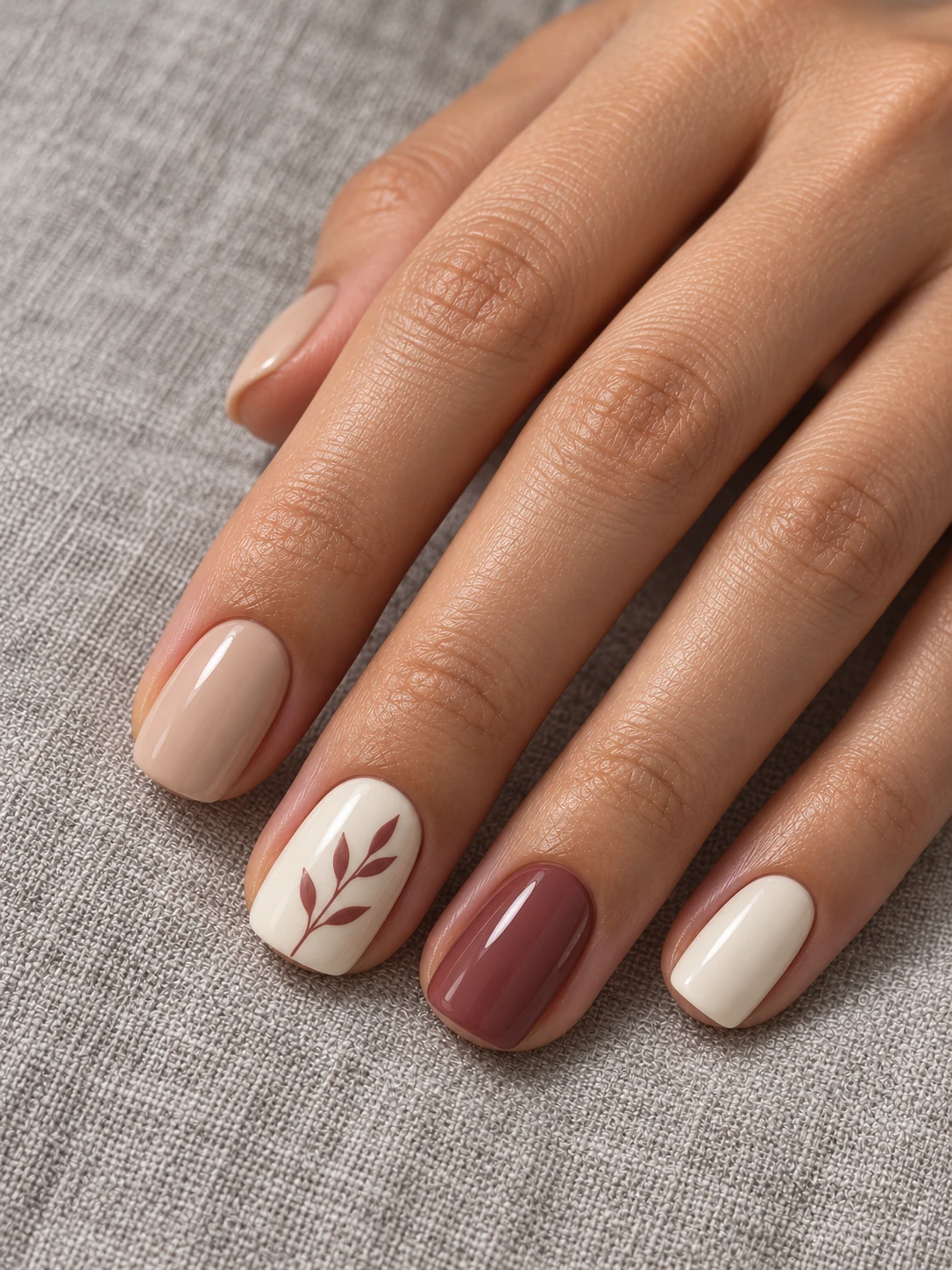
Four complete nail surfaces show nude and cream bases, a red-brown solid nail and a leaf accent. The thumb is partly hidden, so the photograph does not specify a full five-finger layout.
Adapt it to your preference: For a simpler version, keep nude and cream and omit the leaf. To retain red-brown, use it on just one accent nail.
Small floral nails: one flower, a cropped flower or two accents?
A floral outfit does not require flowers on every nail. First decide whether petals, colors or raised texture are the detail you want, then choose the amount of decoration. These original diagrams hold apricot base #E8D4C9, muted-purple petals #7A637E and cream center #E8D79F constant, comparing density and placement rather than products or application.
One flower: leave breathing room
Put one small flower on ring and keep the other four nails solid. This keeps a playful detail without a full patterned set. Smaller is not always clearer; check whether the petals remain distinct at your actual length.
Side-cropped flower: choose the edge
Let part of the flower extend beyond one side, keeping the rest in the same base. Specify left or right and whether the hands mirror. Do not assume missing petals in a cropped reference should be filled in.
Two accents: repeat one flower
Use one flower each on middle and ring, with three solid nails. Repeat the petal and center colors instead of adding leaves, lettering, French edges and raised art at once. Return to one accent if the nail plate is small.
Painted, decal and raised flowers are different requests
A visible flower shape does not identify the material. Hand painting, decals and raised layers need separate confirmation; “floral” does not specify the method. For a flat motif, explicitly omit raised petals, beads and metal centers. If texture matters, ask the artist to assess your actual length, available materials and booking scope first. These diagrams do not prescribe curing or layering steps.
Coordinate patterned clothing and finger placement
Choose one petal color from the outfit and pair it with a quiet base. With a cream shirt or a dress containing muted purple, use apricot solids on thumb, index, middle and pinky, with one purple flower on ring. Add a middle flower only if you choose the two-accent version. For short nails, omit leaves and surrounding dots first, keeping the center readable. Compare physical colors under the same light.
A brief for your nail artist
“Keep my current short length with an apricot base. Put one flat muted-purple flower with a cream center on each ring nail and solids elsewhere. Show one sample to confirm size and petal spacing. Simplify the shape if the plate is small; no leaves, lettering or raised petals. Confirm painting versus decal, materials, time and price rather than assuming an unknown photo technique.”
Complete and download the ten-finger brief · Compare small-heart pairs
Technique context, not search-volume evidence: OPI: Poptical Illusion raised flowers. That tutorial demonstrates raised flowers; the flat layouts here are original alternatives, not reproductions of its procedure.
Short swirl nails: which curve should you keep?
Swirls, marbling and blended effects ask for different results. These original diagrams show crisp, flat curves rather than wet marbling, magnetic reflections or raised gel ribbons. Compare placement using nude rose #D9B9B8, plum #713344 and cream #EEE1D4. Screen colors do not replace physical swatches.
One curve: one accent nail
Use a single plum curve on ring and keep the other four nails solid. Agree on the direction instead of shrinking every turn from a long-nail reference onto a short nail.
Two side curves: keep the center open
Place separate cream and plum curves near one side of ring. Do not join them. For a narrow nail, omit the cream curve and use one line.
Two accents: no crossing lines
Put one plum curve on middle and ring, leaving the other nails solid. Mirror the hands or keep the same direction; specify which before application.
Simplify the short-nail and outfit combination
Make one sample at your actual length and check whether two curves remain separate. Reduce line count or accent count if space is limited rather than making the lines thicker. Try one curve with a patterned outfit or two accents with a solid top. Matching jewelry is optional; the cream line is painted color, not metal or chrome.
A salon brief for the curve placement
“Keep my actual short length and shape, with nude rose on all ten nails. Use option [1/2/3]. Thumb, index and pinky stay solid; middle is [solid/one curve], ring has [one/two] curves. The other hand is [mirrored/same direction]. No crossed lines, blended marbling or raised ribbons. Confirm the physical base and line width on a sample; omit one line if space is limited. Agree on price and time first.”
Record each hand’s direction in the ten-finger card · Choose a fallback if the appointment scope changes
Terminology context, not popularity evidence or a copied tutorial: essie: sweet swirl
Outline nails are more than a tip line: specify a closed frame, opening or one accent
“Outline,” “French” and “negative space” can be interpreted as different placements. Describe where the line runs and where it stops before relying on a style name. These original maps fix cream #EAE0D2 as the base and slate #617E7B for the line. Tip is at the top and cuticle at the bottom. The diagrams do not specify real line width or working distances.
Closed border: two accents
One slate outline on middle and ring; cream solids elsewhere. The border is a closed shape inside the nail, not just a line across the tip.
Open border: specify the opening
Keep the same two accents, with a U-shaped line along both sides and the cuticle end, open toward the tip. “U-shaped” describes this drawing; the salon may use a different name.
Keep only one framed nail
Only ring keeps the closed border; other nails return to solid cream. Compare this first with a printed outfit or several accessories already in the look.
Confirm borders, negative space and short-nail fit separately
The cream here is a colored base, not clear space, bare nail or the natural white edge. Specify transparent negative space separately if desired. If you only want a fine tip line, compare short French tips rather than assuming a full border is equivalent. Check how much base color remains inside the frame at your real short length; reduce accent count or use solids if crowded instead of extending by default.
Compare physical swatches beside cream, gray, navy or printed clothing. The other hand can repeat middle/ring or keep just one accent; specify each hand. For an open border, mark “open toward tip” or your chosen location instead of using an ambiguous “reverse it on the other hand.”
A border-placement salon request
“Keep my actual short length and shape, cream base and flat slate lines. Choose [two closed frames/U-shaped open toward tip/one closed frame]. Frame [left fingers] and [right fingers], solids elsewhere. The line runs [all around/both sides and cuticle end], with [no opening/an opening toward the tip]. This is not tip-only French, clear negative space or a metallic outline by default. Confirm interior space and line width on a sample at my real length; use one accent or solids if needed. Agree on materials, total and time first.”
Compare tip-only short French layouts · Distinguish colored base from clear negative space · Record border placement on both hands
Outline terminology and technique context, not popularity evidence or a copied tutorial: essie texture blur
Fruit nail art on short nails: choose and describe cherry, citrus or strawberry
For a playful date or picnic palette, first decide whether you want a recognizable fruit or only fruit-inspired colors. These original flat symbols are not a brand design or a photo reproduction: cream pink #F2E4DD, berry red #9A3548, fruit yellow #DDAF42 and leaf green #597659. The symbols do not imply flavor, seasonal popularity or a relationship outcome.
Cherry: retain the paired dots and connecting stems
Two fruits and their connecting stems identify this example. If the stems disappear on a short-nail sample, keep one clearer group rather than adding tiny dots. Dots alone can simply be described as a dot pattern.
Citrus: choose a whole fruit or a slice first
This example is one whole-fruit outline with a leaf, not a slice. For a slice, separately specify half/full circle and segments rather than asking only for lemon yellow. Start with one fruit on short nails instead of assuming an all-over pattern.
Strawberry: separate fruit shape and a few seeds
This example separates a tapered fruit, green crown and a few pale seeds. If they merge, reduce the seeds or keep one clearer fruit rather than squeezing every tiny fruit from a reference into a short nail.
Separate the number of fruits from the number of accent nails
- One cherry pair on ring contains two fruits but only one accent nail. Repeating a pair on each hand makes two accents and four fruits. Keep those counts separate.
- For a repeating motif, compare one and two groups on one sample and check the visible base between them. Reduce groups if they are unclear rather than defaulting to extensions. Pixel proportions are not millimeter specifications.
- For mixed fruit, use one cherry accent on the left and one citrus accent on the right with the same base on eight solids. Two accents can connect the hands without placing all three fruits on one short nail.
Confirm the outfit, bag and art method together
With floral or fruit-print clothing, compare one accent against a solid outfit before deciding whether the combination feels busy. Red or yellow bag details can also be echoed through solids alone. Inspect motif readability at your actual length, and choose sheer/opaque coverage and matte/gloss finish separately. A front view cannot identify painting, stamping, stickers or raised charms; confirm method and materials with the artist.
Keep my actual short length and cream-pink base. Use one pair of two cherries with stems on left ring and one whole citrus fruit with a leaf on right ring; keep eight solids, two accents total. Check a sample first; reduce the fruits or use solids if details are unclear. Please confirm technique, whether it is flat, total and time.
Check accent-nail count · Record both hands in the brief · Connect the date outfit plan
Terminology references, not recipes or buying recommendations: OPI Main Squeeze · OPI You're Cherry Sweet。
What nail color goes with a black dress? Choose quiet, contrasting or tonal
A black dress does not require black nails. Try nude when you want the dress and jewelry to lead, red-brown for a color accent, or black for a tonal direction. There is no single guaranteed match, and nail color does not establish attraction or a date outcome.
Compare two physical swatches beside the actual dress fabric, ring and clutch under the same light before choosing art. The three owned, authorized EssaColor AI inspiration images below are not customer photos, outfit trials or branded swatches; the five-finger diagrams are separate simplified proposals.
Let the dress and jewelry lead: warm nude
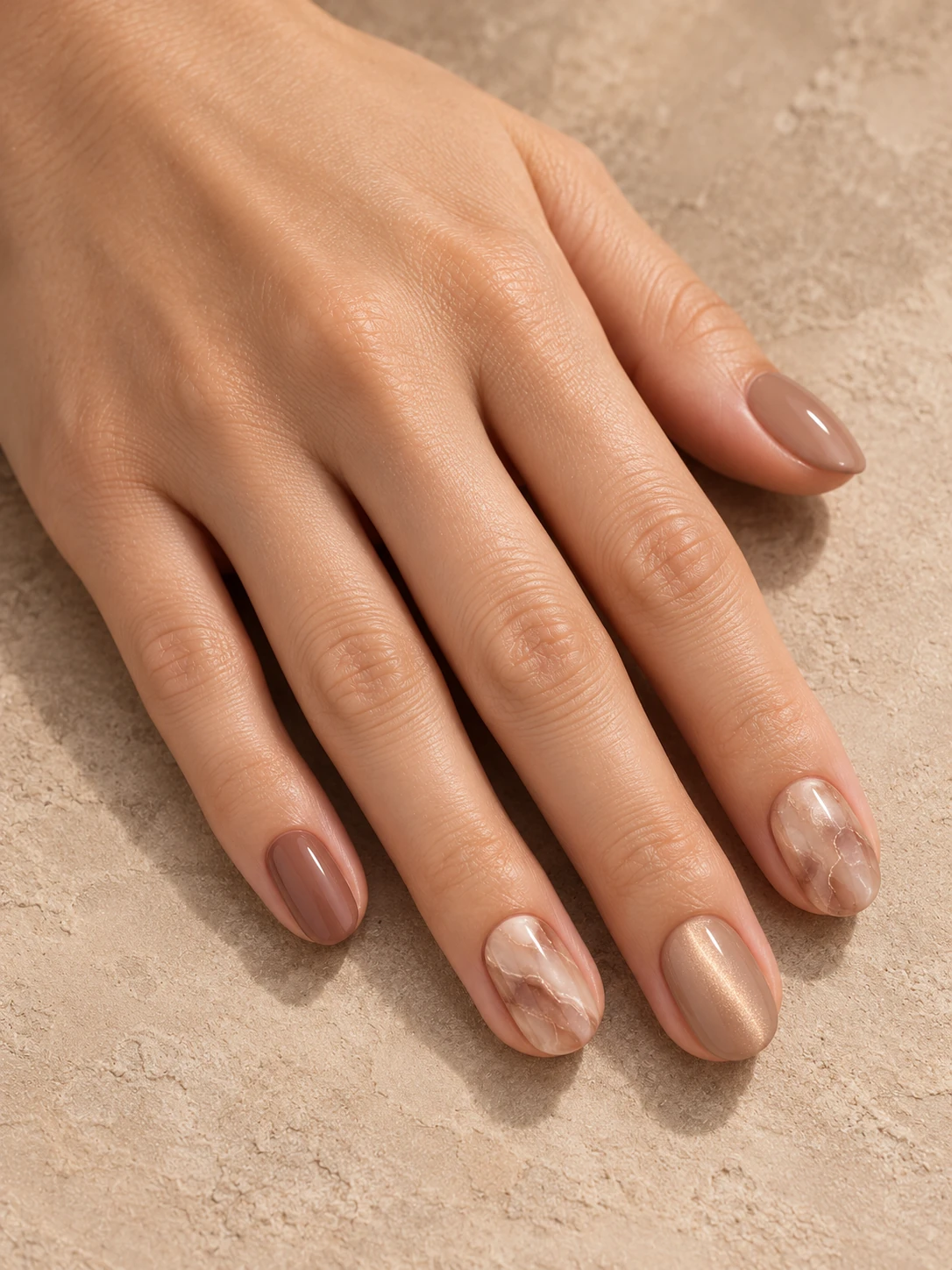
The reference combines warm nude, pale veins and a luminous-looking area. Borrow its base direction rather than copying the veins, reflections or depicted skin tone.
Five-finger plan: Four warm-nude solids and a cream-beige ring nail, or all five warm nude. Decide with a real swatch whether you prefer lighter, similar or deeper contrast to your skin.
Black outfit direction only, not calibrated dress fabric
Illustration codes: #C6A68F / #EFE0D3. Screen HEX values are not polish shade IDs. Only one hand is drawn; confirm the other separately.
Make nails the color accent: red-brown
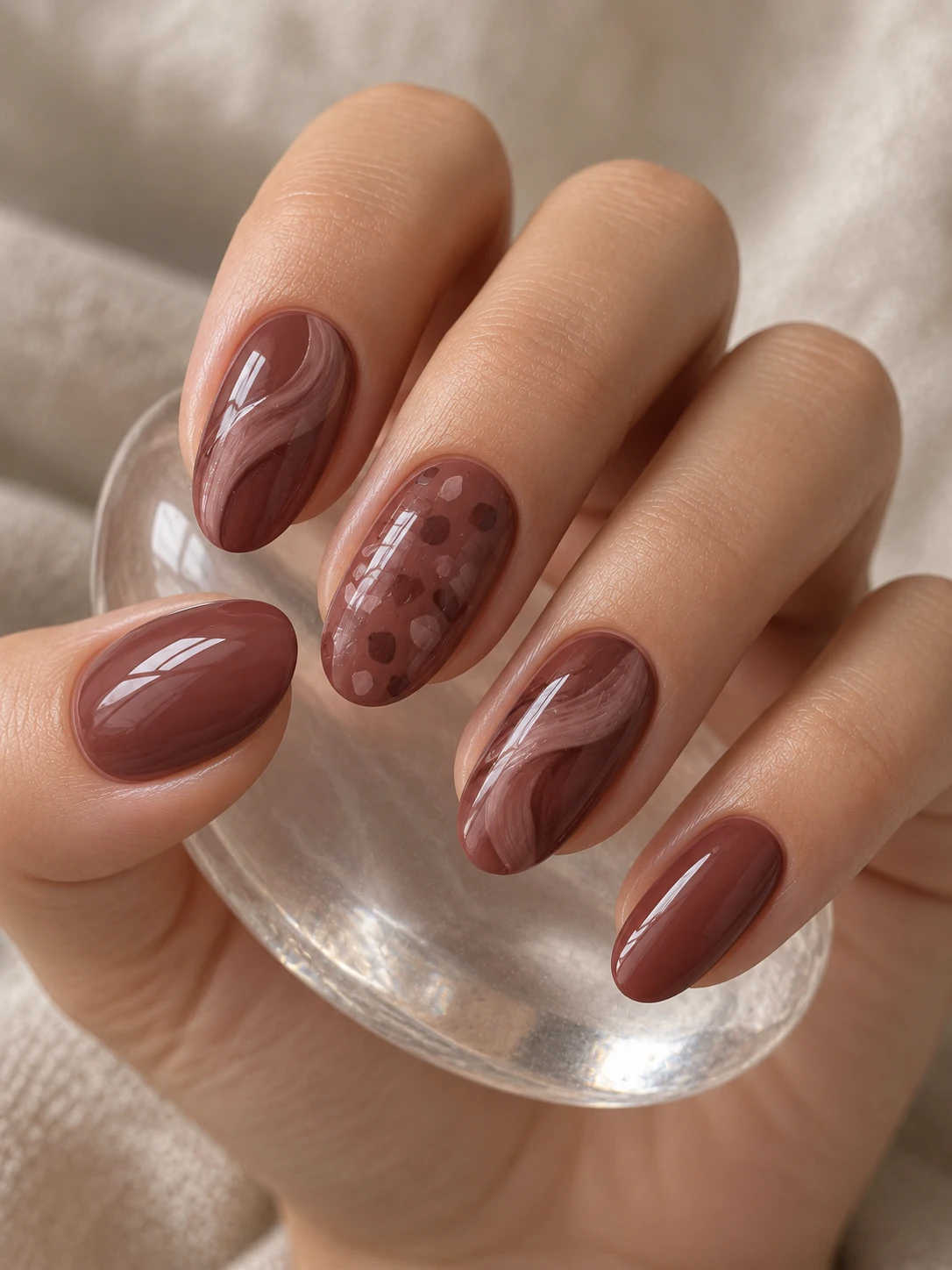
The red-brown reference includes flowing marks and scattered pieces. With a black dress, keep the solid family first and decide whether the color alone gives enough emphasis.
Five-finger plan: Four red-brown nails and a light-nude ring, or all red-brown for one color. On short nails, omit scattered pieces and multiple lines before considering more detail.
Black outfit direction only, not calibrated dress fabric
Illustration codes: #7A3240 / #E8D5C9. Screen HEX values are not polish shade IDs. Only one hand is drawn; confirm the other separately.
Keep a tonal direction: black nails with black dress
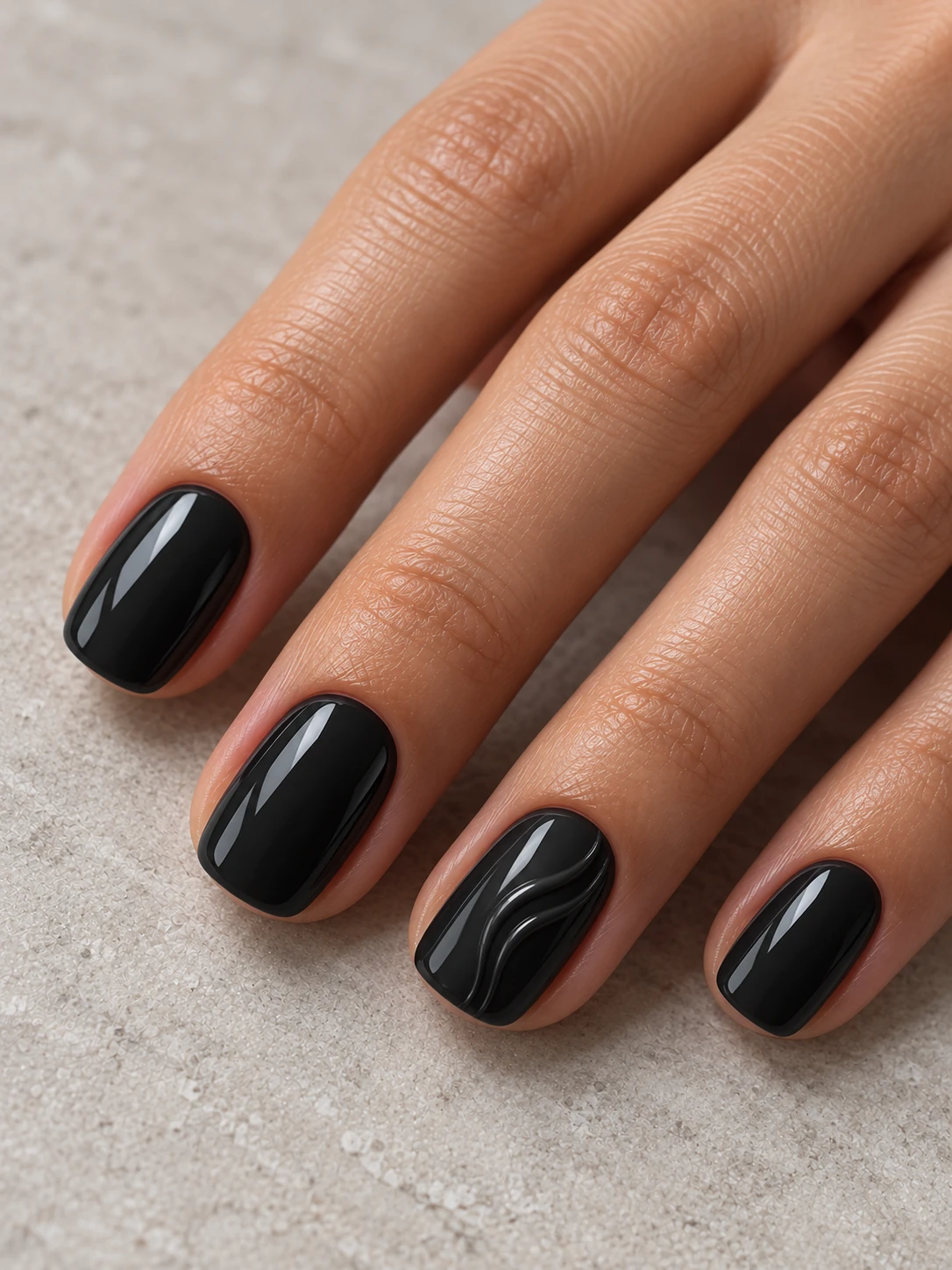
The black reference has strong reflections and curved areas. A photo does not establish relief, chrome material or a technique. State any flat-profile requirement separately.
Five-finger plan: Five black nails, with an optional fine taupe-gray curve on the ring. Keep solids if preferred. Compare matte and gloss separately; shades called black can differ in depth and undertone.
Black outfit direction only, not calibrated dress fabric
Illustration codes: #19191C / #19191C / #B5A698. Screen HEX values are not polish shade IDs. Only one hand is drawn; confirm the other separately.
What changes with the fabric and occasion?
- Matte or simple black fabric: use a color accent or keep it tonal; sparkle is optional.
- Sequins, lace or statement jewelry: compare solids first. One accent per hand is a starting proposal if you still want art; confirm the total across both hands.
- For a date, formal dinner or wedding guest outfit, check the dress code first. Gold does not require warm nails, nor silver cool nails; echo or contrast deliberately.
Four short-nail and swatch checks
- Record your actual length and shape. Solids can carry the look; the reference length is not a reason to require extensions.
- Keep coverage and finish constant while comparing two colors. If both change, make the decisions in two rounds.
- Use the fabric, bag and ring in the same light. Photo exposure can change how black and red-brown read; a screen preview is not a physical result.
- Confirm both hands, profile, actual products, total and appointment time. Fall back to solids if the sample is unclear; the guide does not mean the salon accepted the reference.
I am wearing a black dress and want [quiet nude / red-brown contrast / tonal black]. Keep my actual short length. First compare two swatches with the same coverage and finish beside the dress and jewelry. Confirm both hands using the finger plan above; art is optional. Please agree on profile, products, total and time before proceeding.
Prepare a two-hand brief · Record two physical swatches · Compare jewelry choices · Plan prom clothes and accessories
For birthday, month and wish-inspired ideas, open EssaColor. The product does not guarantee a match to black fabric, skin tone or a branded polish.
Research context: Facetune: nail color for a black dressdocuments the styling question. Its simulator features, matching guarantees and jewelry rules are not adopted as EssaColor capabilities or universal rules. These diagrams and comparison steps are independently written; an existing expression is not evidence of high search frequency.
Stained glass or shattered glass nails? Read the outlines and gaps on short nails
“Glass” can describe outlined panes, scattered shards or a product with a cat-eye finish. The word alone does not specify a material or technique. First ask whether you want connected cell outlines or separate angular pieces, and whether real reflection or translucency is part of the request.
These original diagrams use cream #EFE3D3, blue #719CB4, teal #7EA99B, amber #C59D64 and dark outlines #394651. They are not branded shades, material samples or a transparency effect. Top is the free edge and bottom is the nail base; no millimeter scale is implied.
Large outlined panes: four cells on the ring
Divide the ring nail into four connected blue, teal, amber and cream cells; leave the other four cream. The defining request is a connected outline, not reflection in every cell.
Short-nail fallback: Reduce the number of cells and enlarge those remaining rather than shrinking them all. If lines and colors merge, agree on two cells or a solid.
Partial window: three tip cells
Keep three outlined cells near the ring-finger tip and leave cream below. This does not request a cut-out nail, a French smile line or a clear extension.
Short-nail fallback: Remove tiny pointed corners and keep two larger areas. A single colored edge is a design change to agree separately.
Scattered shards: three separate pieces
Place three separated angular pieces on the ring nail, with visible base between them and no connected window grid. For a light-shifting film effect, separately confirm the actual nail material and sample; these flat shapes do not simulate reflection.
Short-nail fallback: Reduce the piece count and keep gaps. Do not replace scattered angular pieces with dense glitter. Keep actual nail length and agree on one piece or a solid if needed.
Each plan shows one hand with one ring-finger accent; repeating it on both hands makes two accents total. Confirm the other hand and orientation. If an outfit already has sparkle or pattern, compare one accent with a solid sample; this does not promise greater attractiveness.
Separate appearance from the production request
- Choose connected panes or separated angular pieces, then name the accents. If combining both, describe each rather than relying on “glassy.”
- Check line width, cell count and gaps on a sample at actual nail length. Simplify details before assuming extensions.
- Agree on painting, film or another specific nail material, flatness and any separate cat-eye or light-shifting effect. These may be combined but are not interchangeable.
- Confirm samples, scope for both hands, price and time. A photo alone cannot establish thickness, branded shades or behavior under different light.
Keep my actual length with cream bases and one ring accent per hand, two total. I want [four connected panes / partial tip panes / three separate angular pieces], with solids elsewhere. Please confirm the lines, gaps and actual nail-material sample. Agree separately on reflection, cat eye, raised details or extensions. Simplify cell or piece count before adding dense glitter.
Check flat versus raised details · Choose painting, stamping or decals · Write a two-hand salon brief · Compare cat eye and other finishes · Explore birthday, month and wish-inspired palettes
Primary references: OPI: stained glass effect with cat-eye finish · Vogue Taiwan: glass-shard nail interview. These show that the terms can describe different looks. Sales, popularity, wear-time and application claims are not adopted; no external images are copied.
Daisy, tulip or rose on short nails: choose shape before placement
“Small flowers” leaves the head structure unspecified. Use these original flat sketches to agree on essential shape, then use the placement guide for a whole flower, crop or two accents. These are discussion cues, not botanical identification or a promise of identical handwork.
Fixed references: cream #EDE3D6, ivory #FAF3E9, pink #C88999, deep pink #875163, leaf green #5C7968 and yellow #C8A04B. HEX values are not branded shades; flat sketches do not specify products, relief or gloss. Each option has one ring flower and four solids; repeating both hands makes two flowers on two nails. Top is the free edge and bottom the base, without a millimeter scale.
Daisy-inspired: petals radiate around a center
Eight ivory petals surround a yellow center in this sketch. Keep center and petals visibly distinct rather than calling one white patch a clear daisy. Eight is a choice for this diagram, not a botanical rule.
Short-nail simplification: Omit leaves, repeated flowers and tiny center dots first. If petals still merge at actual size, agree on a generic flower or solid rather than promising daisy recognition.
Tulip-inspired: a cup-shaped head and upright stem
A head with three upper points narrows at the bottom, above one stem and leaf. It differs from loose petals around a circular center. The points are an illustration cue, not a real petal count, and stem length does not guarantee a longer-looking nail.
Short-nail simplification: Remove the leaf or shorten the stem first while retaining the cup. If only the head remains, specify a stemless head rather than adding nail length for a complete stem.
Rose-inspired: curled lines inside the flower head
Keep three darker curved lines within a rounded rose-pink head. They suggest curled petals, not a raised rose or exact natural flower. Removing every inner line leaves a round patch rather than automatically satisfying a request for rose detail.
Short-nail simplification: Remove leaves and extra inner lines first, then check that the retained curl reads clearly. Do not crowd in more fine lines; outlines, filled shapes and raised roses require separate agreement.
Four checks before the appointment
- Choose shape separately from placement. Name the center, cup or curled petals that must stay, and leave unclear reference details unresolved.
- Try one at actual length. Specify whether leaves, stem or inner lines may go rather than silently switching a complete flower to a crop.
- Record fingers and flower counts for both hands. Eight petals on one flower are not eight flowers. Confirm head and stem direction rather than guessing photo orientation.
- Flat painting, stamping, decals, dried flowers and raised charms are different requests. Ask the artist to confirm available designs, actual size, products, finish, total and time.
Keep my current short length and cream base. One [radial-petal flower with yellow center / cup head and short stem / rose-inspired head with curled inner lines] on each ring, with solids elsewhere. Check actual size first; omit leaves or repeated decoration before changing the flower shape, and ask me first. No assumed extensions or raised charms. Please confirm products, total and time.
Then choose a whole flower, crop or two accents · Confirm flat versus raised · Write a two-hand brief · Compare pattern density beside clothing · Explore birthday, month and wish-inspired palettes
Source context: Sally Beauty / OPI: daisy · Cosmopolitan Taiwan: tulip nails · Maniology: rose designs. These establish existing floral language, not current popularity. Sketches and simplifications are original; images, brand formulas and application settings are not copied.
Do denim nails mean blue polish or fabric-inspired art? Choose the look for your outfit
For a coffee date in jeans, a jacket or a denim skirt, echo the blue alone or add one seam or pocket accent. Denim nails can mean a color or clothing-inspired artwork. State which meaning matters instead of assuming a whole-jeans design. Outfit suggestions do not promise attraction or a date outcome.
These original five-finger maps hold blue #5F7E98 and pale-tan lines #D4B890 constant. Tip is at the top and cuticle at the bottom. They are not branded artwork, millimeter dimensions, actual fabric or a metallic finish. No external reference images are used. The plans are alternatives rather than seams, pockets, zippers and rips squeezed onto one short nail.
Denim blue only: five solid nails
Keep a muted blue without weave, seams or pockets. Denim blue is not a fixed branded shade and does not automatically mean matte.
Short-nail fallback: Keep short nails and solids; confirm depth, opacity and finish on physical samples. A fabric theme does not require thickness or a textured surface.
Both-hand count: Repeating this makes ten solids and zero patterned nails.
A stitched accent: one side seam
Ring carries one pale straight seam and four short stitch marks; the other four nails stay blue. Lines are flat artwork, not thread, sewing or a specified material.
Short-nail fallback: Keep the seam and fewer short marks. If crowded, reduce stitches instead of squeezing two dense rows into a small plate.
Both-hand count: One ring accent per hand makes two patterned nails and eight solids.
A pocket accent: outline and opening
Ring has one independent five-sided pocket outline, with its opening toward the tip; four nails stay blue. It is not a French tip, an actual opening or a raised pocket.
Short-nail fallback: Keep the complete outline and blue margin, omitting interior decoration. If cramped, agree on a seam or solid instead; this is a design change.
Both-hand count: One ring accent per hand makes two patterned nails and eight solids.
Coordinate with clothes without guessing production from a photo
If clothing already has visible topstitching, rips or large pockets, compare solids with one accent before repeating the detail. A cream top can share a light line color; beside a dark-blue jacket, compare a lighter blue sample. Clothes and polish need not match exactly, and a screen cannot prove a physical match. Friends can share the blue direction while choosing solids and seams separately.
- Choose color, seam or pocket; name fingers and accent counts for each hand.
- Confirm whether the pocket opening faces tip or cuticle with an arrow rather than automatically mirroring a photo.
- Agree separately on gloss/matte and flat/raised. Illustrated rips or zippers do not request cutting a nail or prove real metal or fabric. Discuss those materials separately if present in a reference.
- Check line width, outline, method, total and time on an actual-length sample. Stamping, decals and painting are not interchangeable, and ready-made motifs may not resize freely.
Keep short nails and muted blue bases, with one [pale-tan seam / pocket outline] on each ring, two accents total and solids elsewhere. Pocket openings face the tips. Flat artwork, without real fabric, metal, raised details or cut-outs. Show an actual-length sample; simplify lines or use solids if crowded, confirming the change first. Please specify finish, products, total and time.
Choose a palette beside your outfit · Separate flat from raised art · Confirm the art method · Write a two-hand brief · Explore birthday, month and wish-inspired palettes
Terminology source: Maniology: Cute Jeans denim-inspired motifs. This establishes denim-clothing motif terminology, not current popularity or ease of production. Images, artwork, application steps and prices are not copied.
How do I request music nails? Separate icons, beams and score requirements
For a concert, music-themed date or coordinated friend set, choose the musical graphic before the colors. These three original plans use cream #F0E3CC and deep blue #25364C; they do not reproduce a song or concert merchandise or guarantee a polish match.
One note: keep the head and stem
One filled head and upright stem on ring, with solids elsewhere. No clef, time signature or pitch is specified; this is a music-themed icon.
A beamed pair: separate the two heads
Two heads, two stems and a connecting beam on ring. Confirm one joined group versus two single notes on separate fingers; those are different layouts.
Staff decoration: not a song excerpt
Five horizontal lines and a note on thumb, with solids elsewhere. This original diagram has no clef, key or time signature and is not for identifying a melody or performing music.
Simplify short nails before squeezing in staff lines
If five lines and the head cannot remain distinct, choose plan 1. A beamed pair can become a single note, but record that substitution instead of calling it an identical smaller version. Each plan has one accent per hand: two accents and eight solids if repeated. Friends can share an icon with different bases; confirm each person’s fingers and lengths separately.
If you want a particular piece of music
Supply a clear score you are entitled to use, mark the exact measures, clef and orientation, then ask the artist what remains readable at actual nail length. Do not infer a tune from decorative art. If it is too small, keep the score on a separate card or accessory and simplify the nails. These diagrams do not identify music or generate scores.
- Choose a single note, beamed pair or staff decoration and say whether readable notation is required.
- Mark hand and finger, including the number of heads on each accent.
- Check head, stem, beam and base gaps separately on short nails.
- Confirm flat painting, stamping or decals, total and time; do not automatically add extensions or raised charms.
Keep short nails with cream bases and flat deep-blue music art. Choose [single note / beamed pair / staff decoration] on each [ring / thumb], two accents total and solids elsewhere. This is a decorative icon, not a recognizable song. Confirm a single-note fallback if details merge. Please check actual length, method, hand orientation, total and time.
Write a two-hand brief · Confirm the art method · Compare shapes and detail · Plan coordinated sets separately
Terminology context: Bonnie H. music-note nail tutorial, Beauty Launchpad (2013). This supports the existence of music-note nail terminology; these original plans do not copy the tutorial or establish current popularity.
How do I brief zipper nails? Separate teeth, opening and pull
With a zip jacket, denim or concert outfit, identify the zipper component before choosing colors. These original five-finger plans use cream #F0E3CC and deep blue #25364C without copying garment brands or tutorial artwork. All are flat drawings, with no metal, physical opening or functioning zip.
Closed teeth: alternate the two sides
A vertical closed strip on ring, with four short teeth per side, eight total, and no pull. Two straight lines or rows of stitches are not automatically a zipper.
A V opening: mark the open end
On ring, two toothed edges open toward the tip, with the V point toward the base. Four short teeth per side; the opening is flat base-color space, not a cut into the nail.
A pull tab alone: not a full zipper
One flat pull-tab icon on ring, without teeth. Cream base color forms its opening; no piercing or moving hardware is implied.
Keep spaces between teeth on short nails
Compare at actual length first. If eight teeth merge into a solid line, reduce to three per side, six total, and record the change rather than shrinking everything. An unclear V can become a closed strip; a tiny tab opening can become a solid mark, but it is a changed detail. Each plan has one accent per hand, two art nails and eight solids when repeated.
If your jacket already has a prominent zip, compare the tab-only plan with the toothed strip before copying every garment detail. Friends can share one component with different bases; confirm lengths and hand orientation separately. Screen blue is not a polish code or a metallic effect.
- Choose closed teeth, V opening or tab and mark the fingers.
- Specify teeth per side and opening toward tip or base; do not assume mirroring.
- Check tooth gaps and tab space at actual length; agree on a six-tooth fallback if needed.
- Confirm flat painting, stamping or decals, total and time; assess actual hardware separately by size and profile.
Keep short nails with cream bases and flat deep-blue [closed eight teeth / V-shaped eight teeth / tab alone]. One ring accent per hand, two art nails total and solids elsewhere. Open the V toward the tip. If teeth merge, confirm three per side as the fallback. Do not cut the nail or assume a metal tab. Confirm hand orientation, method, actual sample, total and time.
Compare denim seam details · Confirm rotation or mirroring · Separate flat and raised details · Write a two-hand brief
Terminology source: Howcast: Unzipped Zipper Nail Design. The actual transcript distinguishes the V, teeth and tab. Only component terminology is used; the tutorial, drying times and product advice are not reproduced or treated as current popularity evidence.
More patterns and detail options
Zipper nails: teeth, a V opening or a pull tab?
Music nails: a single note, beamed pair or staff decoration?
With denim outfits: blue solids, seams or a pocket motif?
Beyond five-petal flowers: compare daisy, tulip and rose shape requirements
Does your reference say “glass nails”? Separate outlined panes from scattered shards
Wearing a black dress? Compare quiet nude, red-brown contrast and tonal black nails
Dinner-date long nails: red-brown, cream and gold
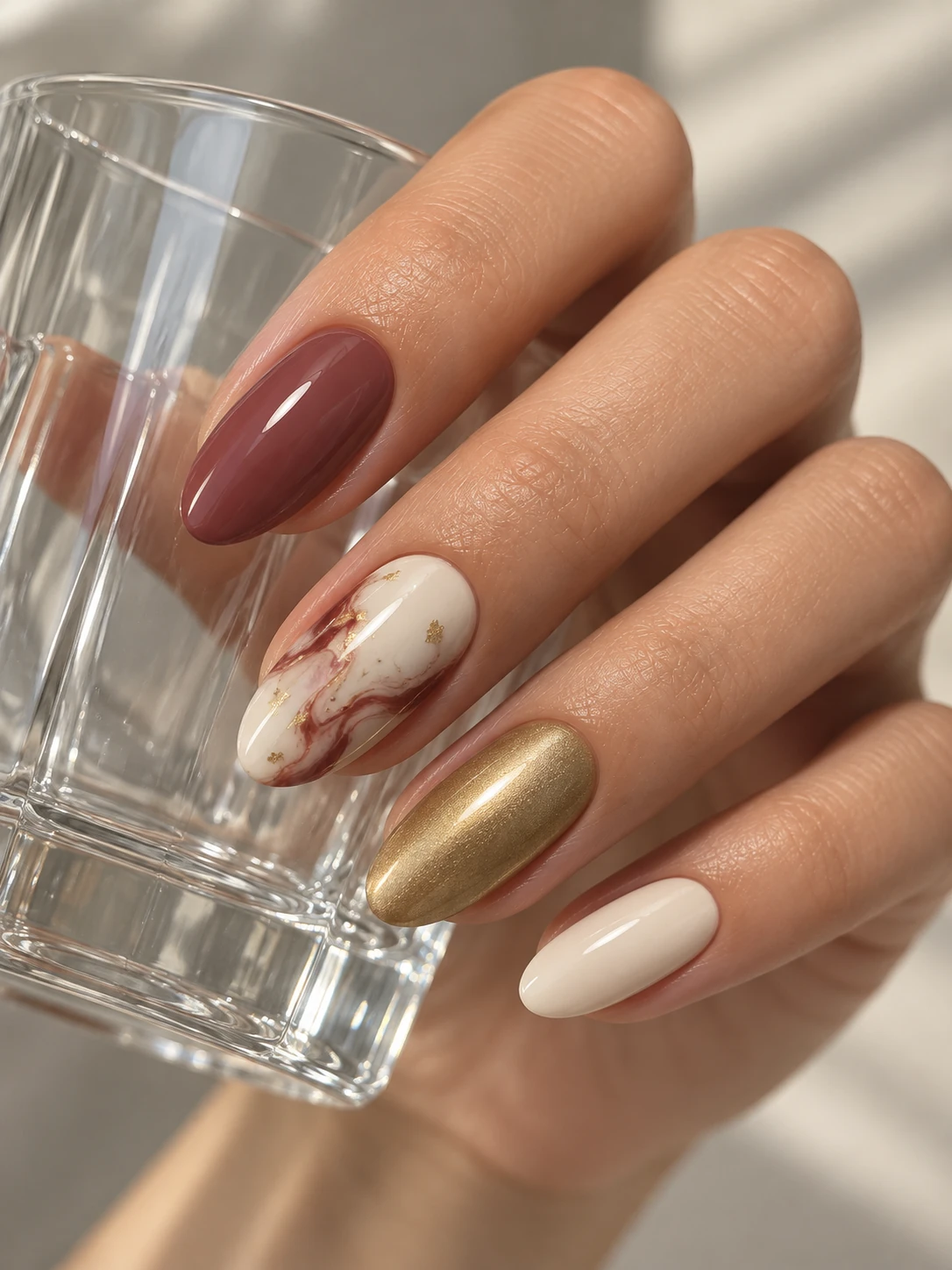
The long almond design combines red-brown solids, a cream marble detail and one full gold nail. It uses more gold than the fine-line option above and is not an exact result for the burgundy palette.
Adapt it to your preference: For less sparkle, replace the full gold nail with cream and keep only a small gold detail. For short nails, omit the marble pattern to reduce detail density.
A tonal alternative: brown solids and texture
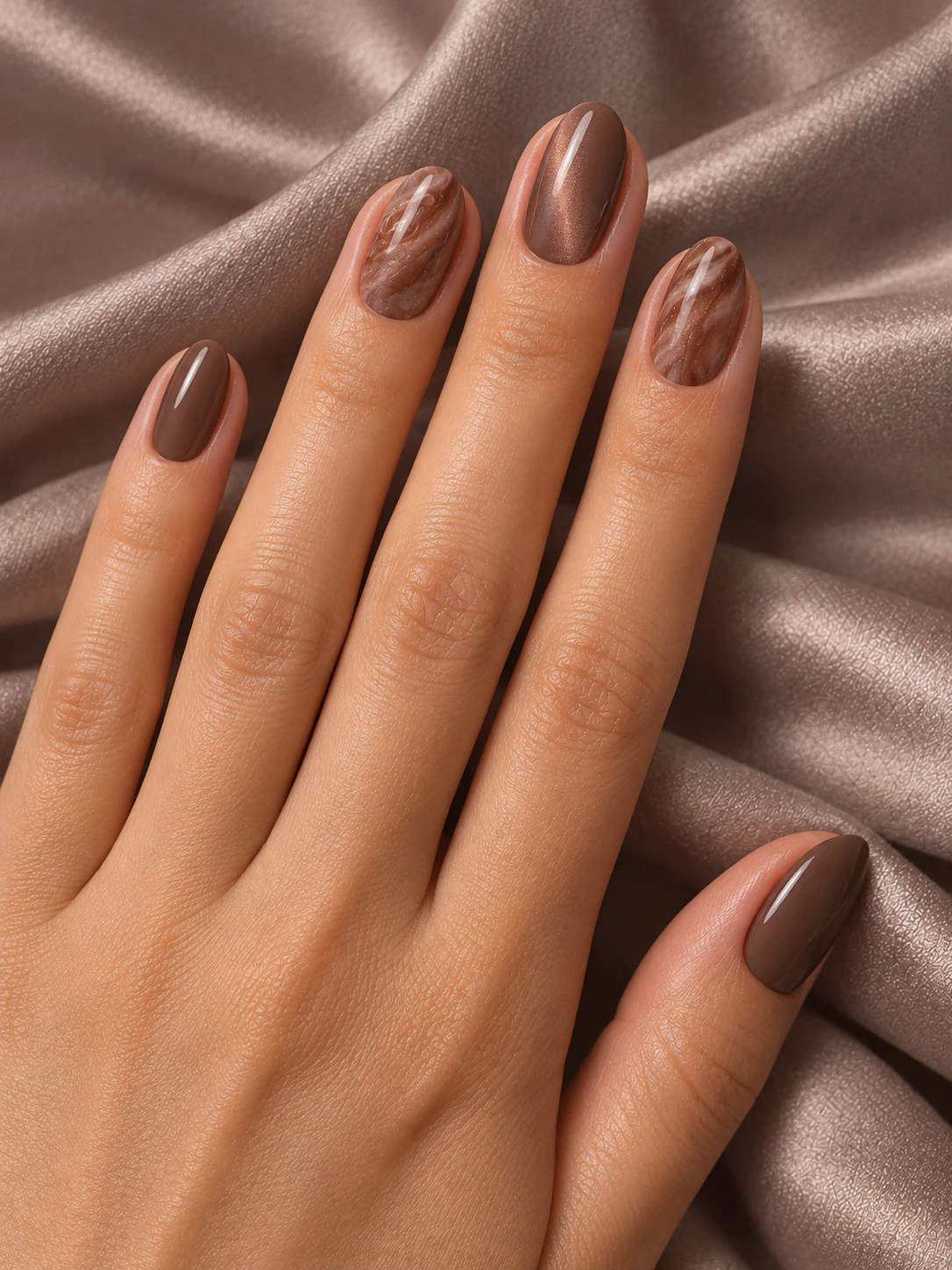
Brown is the main color, with lighter and darker texture on some nails. This demonstrates tonal variation, not a short-nail design or an exact chocolate-and-oat two-color result.
Adapt it to your preference: Keep texture on one accent nail and use a matching solid shade elsewhere. Compare actual polish depth and sheen with your nail artist.
Common questions
Are red or nude nails better for a first date?
Neither is universally better. Red creates more contrast; a nude close to your preferred tone can feel quieter. Choose the effect you like and check it against your outfit and physical swatches.
Can short nails work for date night?
Yes. Keep one main color and one supporting shade, with a single small accent if desired. There is no requirement to add length for a romantic look.
Can nail colors attract my crush?
No reliable attraction claim is made here. A manicure can express your style, but it cannot predict or control another person’s feelings.
Does the tool compare two birthdays?
No. These ideas use the existing individual palette tool; they do not offer a two-person compatibility reading.