Fall Nail Colors: Burgundy, Brown & Blue-Gray Ideas
Start with this decision
For fall nail colors, start with burgundy for a red accent, chocolate brown for a warm neutral, or blue gray for a cooler contrast. Keep four nails plain and one accent per hand, then compare physical swatches for opacity and finish. These are editorial starting points, not a popularity ranking.
| Your goal | Color direction | What to confirm |
|---|---|---|
| Warm red accent | Burgundy + cream | Four burgundy nails, one cream accent; keep metallic details optional. |
| Warm neutral | Chocolate + oat | Four brown nails, one oat accent; use a solid set for less detail. |
| Cool contrast | Blue gray + midnight | Start with blue gray; reserve midnight for one accent or narrow edge. |
See the reference, then decide what to keep
These are owned EssaColor AI-generated inspiration images, not customer photographs, branded swatches or proof that a technique is feasible. Each reading is followed by a separate simplified five-finger plan; it is not a reproduction of the image.
Red-brown with flowing detail
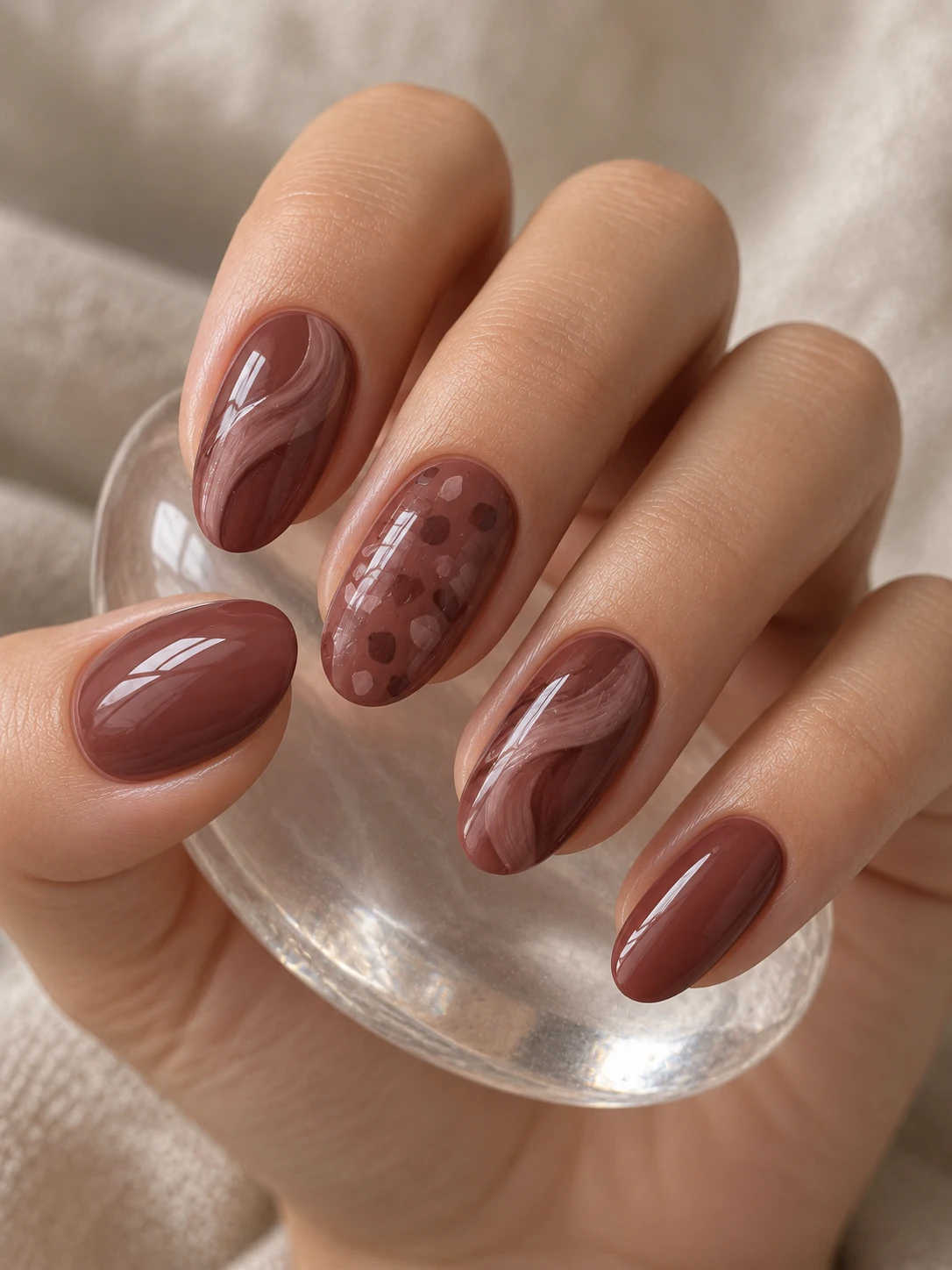
The image combines red-brown solids, flowing lines and scattered pieces. Keep the color family first; ask separately about the decorative material.
Five-finger adaptation: Thumb/index/ring/pinky: red-brown solid. Middle: one red-brown curve on a lighter base.
On a smaller surface, use one curve and omit scattered pieces.
Chocolate brown with lighter movement
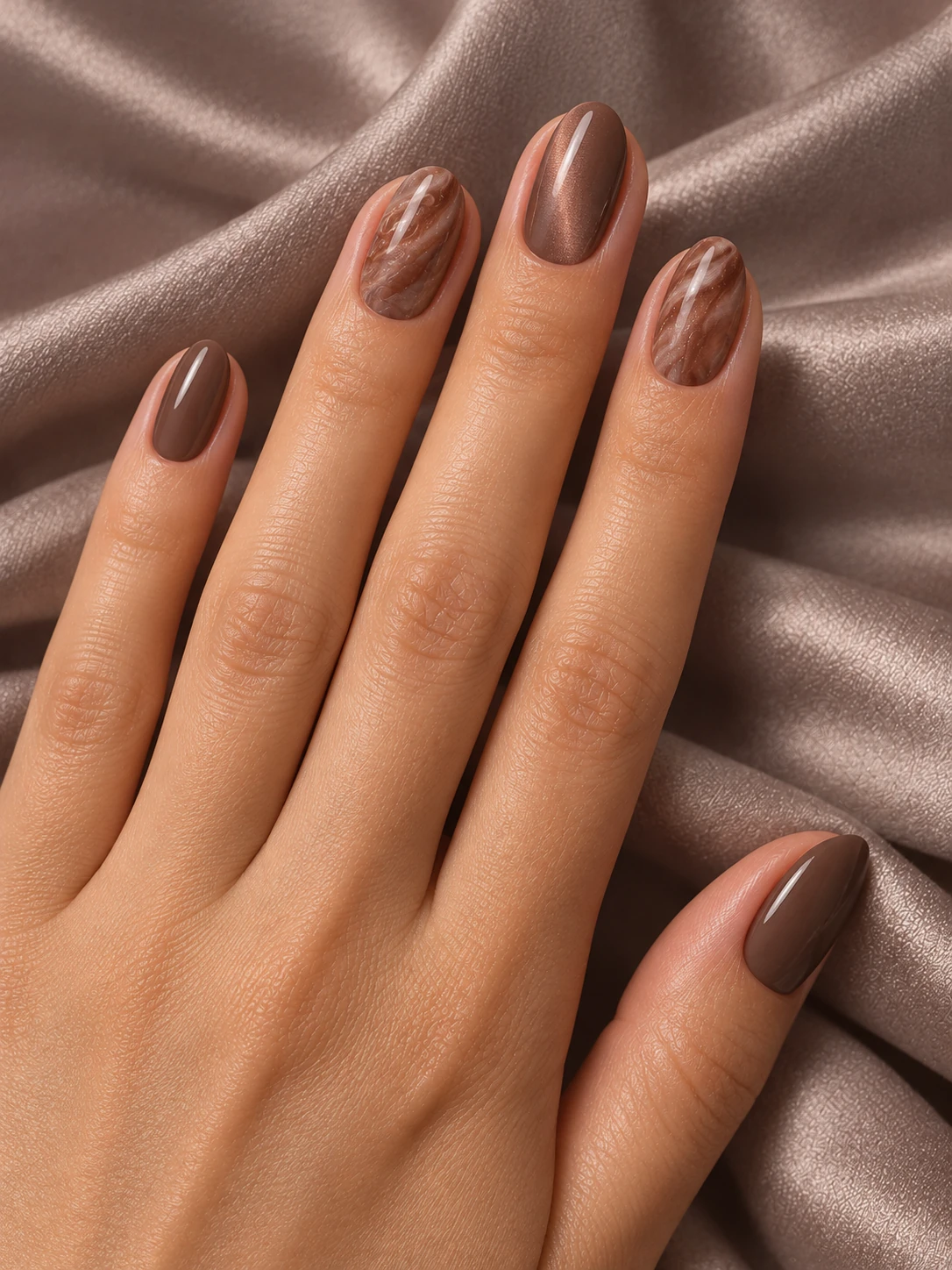
The reference mixes brown solids, lighter flowing texture and a luminous-looking area. That appearance does not identify the product or application method.
Five-finger adaptation: Thumb/index/middle/pinky: chocolate solid. Ring: oat base with one brown line.
Use the plain base on every finger if the line feels crowded.
Blue gray with a small patterned area
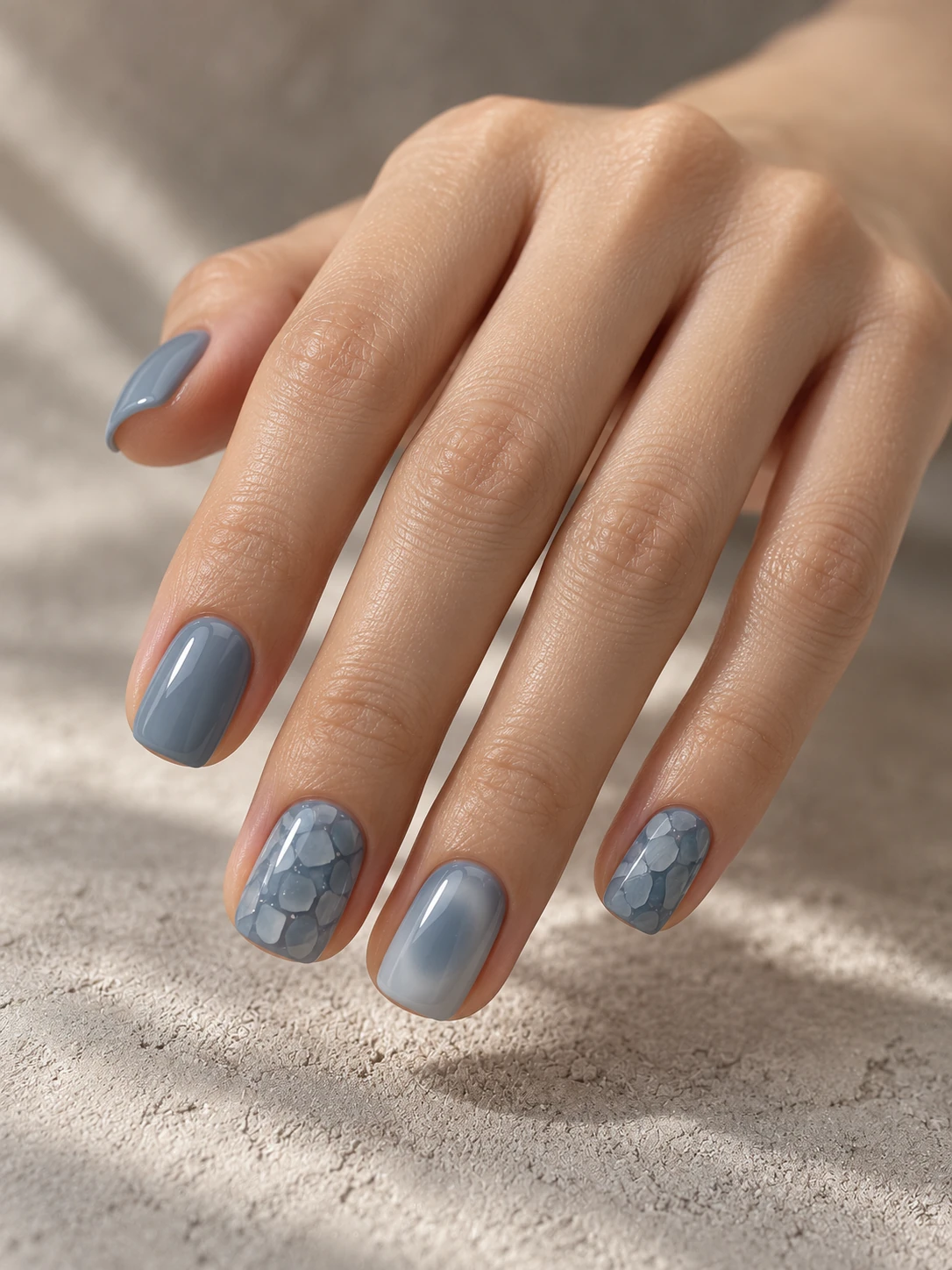
The image uses blue-gray solids beside pale irregular cells. Choose the amount of pattern independently from the base color.
Five-finger adaptation: Thumb/index/middle/pinky: blue gray. Ring: blue gray with a small pale side patch.
Keep the side patch small or omit it; do not compress a full pattern into the tip.
Finger plans run from thumb to pinky and describe one hand for discussion; confirm the other hand separately. Color names indicate a direction, not a screen-to-polish purchase code. Write a brief for both hands
Burgundy + cream
#702F40 / #F0E3D1 / #B99463
Use burgundy as the main color, cream on one or two nails and gold for a thin line. For short nails, try burgundy with one cream accent.
Chocolate + oat
#604438 / #D8C3A7 / #AC8069
Alternate chocolate and oat for a cohesive set. Keep office nails solid and compare physical polish swatches before application.
Midnight blue + blue gray
#20375D / #929BAE / #EEDAC5
Use midnight blue as the main shade, blue gray as a transition and nude beige as negative space; keep metallic details to one or two fingers.
Burgundy fall nails for short nails: a five-finger layout
From thumb to pinky, use burgundy, burgundy, cream, burgundy and burgundy. Add just one fine gold line on the ring finger. For a quieter office look, skip the gold and keep four dark nails with one light accent. Round or short squoval shapes are options; ask your nail artist to confirm the workable length.
Chocolate brown office nails: how to soften a dark palette
Put oat on the middle and ring fingers and chocolate on the other three. For a lighter version, use oat bases with thin brown French tips. Cream and oat are not universally flattering shades: try a physical swatch under the same light and decide whether you like its contrast with your skin.
Blue-gray fall nails: outfit and placement ideas
Blue gray can echo gray knitwear, dark denim or a cream coat; this is styling advice, not a fixed rule. Try midnight blue on the thumb, index and pinky, blue gray on the middle finger and nude beige on the ring finger. For lower contrast, use blue gray on all five nails and reserve midnight blue for one fine border.
A brief you can show your nail artist
I want short fall nails with four burgundy nails and one cream accent, plus one fine gold line. Please show me physical polish swatches first. The screen HEX values are references rather than exact branded polish shades; adjust the length and materials to my nails.
Turn inspiration into a personal palette card
You can take these three editorial sets directly to an appointment. To add a target month and personal wishes, generate three further palettes with EssaColor and download color cards and five-nail production notes. The tool does not read skin-tone photos, and its generated sets may differ from these examples.
Turn a palette into nail ideas
Decide the main-color balance, then choose nail shape and details. Solid color, French tips and fine lines keep a palette clear. Cat-eye, gradients and raised details require suitable materials and your nail artist’s technique. EssaColor provides color cards and production notes; screen previews do not reproduce physical materials.
Common questions
What nail colors work for short nails?
Start with one or two shades. Nude, soft pink and deep burgundy can all work on short nails. Shape, application and personal preference matter; there is no single universal best color.
Can I buy an exact polish shade from a HEX code?
An exact match is not guaranteed. HEX describes a screen color. Displays, polish brands, base coats and lighting affect the result, so compare physical swatches first.
Does EssaColor automatically match my skin tone?
The tool uses a birth date, month and wishes to create palettes and styles. The nail-image upload route can identify nail-surface colors, but it does not detect skin tone or undertone. Adjust colors with your nail artist.
Why this topic
Google Trends checked October 10, 2026, for US web searches over the past 90 days included “fall nail colors” and “fall nails 2026” among the first five rising queries for “nail ideas”. This supports the seasonal topic, not sales or rankings for the colors above. Google Trends
Create your monthly nail palette
Matte or glossy in the same color? Separate shade from finish
If you like a deep autumn shade without adding more colors, change where the finish sits. These original sketches hold plum-brown #69434D and a short squoval outline constant. White highlight symbols mark glossy areas; they are not painted stripes. This is not a reflection simulation or a guarantee that physical matte and glossy samples have identical apparent lightness.
All matte: one low-shine finish
Matte
Matte
Matte
Matte
Matte
All glossy: one reflective finish
Gloss
Gloss
Gloss
Gloss
Gloss
Matte set with glossy ring accents
Matte
Matte
Matte
Gloss
Matte
How to compare without changing two things at once
- Use the same physical color, comparable coverage and your actual length for two samples, changing the finish only. Record products and let the nail artist confirm compatibility.
- Compare under the same indoor light, then rotate the samples near daylight. Reflections move with the angle; painted lines do not. A bright white mark in a reference photo is not automatically white nail art.
- Compare beside the real outfit fabric. If a glossy bag, satin or metal jewelry already stands out, try a small glossy accent; an all-gloss set is also valid. Choose the combination you actually enjoy.
Short nails and a booking brief
For short nails, begin with solid color without raised art, chrome powder or glitter. If you want same-color glossy French tips, check whether the fine edge is visible at your actual length and lighting. A full glossy ring nail is a simpler alternative. Matte does not mean opaque, and glossy does not mean chrome, glitter or cat-eye.
“Keep my current short squoval length. Show matte and glossy samples using the same plum-brown base. Make both ring nails fully glossy and the remaining nails matte. No painted white stripes, chrome powder, glitter or raised decoration. Confirm physical coverage and both finishes before the full set. HEX gives base-color direction, not a brand or processing time.”
Compare transparency and coverage · Thin versus wide tips · Read reflections in a reference
Technique context, not search-frequency or durability evidence: OPI: 5 ways to use matte top coat. It describes combining matte and gloss in one manicure. The layouts here are original and do not prescribe its branded products.
Short Halloween nails: one pumpkin, a small ghost or color alone
Halloween nails do not require symbols on every finger. Decide whether the priority is a party, daily outfits or simply autumn color, then choose one accent. These three original EssaColor screen layouts are not branded shades, physical samples or popularity rankings. Repeat by finger name on both hands unless your brief says otherwise.
Pumpkin accent: warm color without all-over art
#A96438
#A96438
#E9D6BC
#E9D6BC
#A96438
Pumpkin brown and oat, with a single pumpkin on ring. Beside cream knitwear or dark-brown clothing, compare the main color with the outfit before adding motifs. On short nails, omit faces, teeth and vines.
Small ghost: one pale motif
#35323D
#35323D
#D8CAD9
#35323D
#35323D
Charcoal and muted lavender, with a cream ghost silhouette on ring. Keep two eye dots without requiring raised or glow-in-the-dark material. Replace the motif nail with cream solid color if you prefer no characters.
No motif: keep it after the event
#5C3549
#5C3549
#D9C3B4
#D9C3B4
#5C3549
Deep plum and warm nude use color rather than holiday symbols. Choose it if you prefer fewer motifs or a set that pairs with everyday clothes; it does not override workplace dress rules.
Short-nail simplification: silhouette before details
Ask for one sample at your existing length. For the pumpkin, prioritize the outline and short stem; for the ghost, the silhouette and two eyes. If details merge, simplify or choose solid color instead of assuming extensions are required. Diagram proportions are not millimeters, and a flat motif does not guarantee a decal or hand-painted version fits the appointment time.
Choose for the party and the following days
With an elaborate outfit, one main color or one motif nail may be enough. Black clothing can leave an oat-and-pumpkin accent visible; cream clothing can contrast with deep-plum solids. Choose the motif-free plan if you do not want character art after the event rather than assuming Halloween requires a new full set. Color choices do not guarantee protection, luck or social outcomes.
A brief for your nail artist
“Keep my current short squoval length. On both hands, use pumpkin brown on thumb/index/pinky and oat on middle/ring. Add one flat pumpkin only on ring, without a face, teeth or vines. No raised charms or glow effect. Show physical swatches and one sample first; if the motif is unclear, tell me before switching to oat solid. Confirm removal, materials, time and price.” For the ghost plan, write the charcoal/lavender finger order separately rather than changing only the motif name.
Complete and download your ten-finger brief · Adapt to the actual nail shape
Seasonal motif context, not a popularity index: OPI: Halloween nail designs. The palettes, diagrams and simplifications above are original rather than reproductions of its products or procedures.
Short marble nails: keep a main vein or a small texture area?
“Marble” can mean crisp veins or a softly blended pattern. Specify the edge you like rather than expecting one word to identify a technique. These original line maps use cocoa #604438, cream #EEE1D4 and taupe #9B8B81 to show base and vein placement, not wet diffusion, translucent layers or natural stone.
One veined accent: keep the base visible
Use a cream ring nail with one main vein and a short branch; keep the other four brown solids. Do not squeeze every tiny branch from a long reference onto a short nail.
Partial texture: leave one side quiet
Keep short veins on one side of ring and visible cream elsewhere. You can mirror the hands; agree which side before application.
Two accents: do not double the detail
Use sparse veins on middle and ring, with solids elsewhere. They do not need identical line-by-line patterns; agree on the light/dark balance and open base first.
Short nails, clothing and technique choices
Check one sample at your actual length so veins do not merge into a gray block. Omit branches or reduce to one accent instead of extending nails for space. Compare this palette beside plain cream knitwear, brown or black; with a busy print, choose one accent or all cocoa solids. If you want soft blending instead of linework, say so and inspect a real material sample. A photo alone does not establish painting, decals, water marbling or another technique.
A marble-reference adaptation brief
“Keep my real short length and shape. Use option [1/2/3]. Thumb, index and pinky are cocoa solids; middle is [cocoa/cream with sparse veins]; ring is cream with [one main vein/partial side texture]. Hands are [mirrored/same direction]. Confirm crisp veins versus soft blending first. No foil, raised stones or extra colors. Omit branches if the sample is crowded; otherwise use solid. Confirm materials, time and quote.”
Put both hands into the salon card · Compare crisp swirl lines
Tortoiseshell on short nails: choose patch scale, coverage and accent count
This example uses amber, brown and dark irregular patches to discuss tortoiseshell placement, distinct from the existing leopard rosettes and marble-vein layouts. These original flat maps show placement only, not physical layering, sheerness, gloss or polish materials. Screen colors are not brand shade numbers.
Two full accents: check patch scale first
Amber and dark/light patches on middle and ring; cream solids elsewhere. Check a sample at your real short length rather than compressing every patch from a long-nail photo into small dots.
One partial accent: define its boundary
Only one tip corner of ring has the pattern; the rest is cream. A partial motif is not automatically a full French tip. Mark the corner and its coverage first.
One full accent: reduce patterned nails
Only ring keeps the full pattern; middle returns to cream. Compare this first if a scarf, bag or outfit already has a strong pattern.
Fixed example colors: cream #EAE0D2, amber #C58A43, brown #855731 and dark brown #3C2B25. The other hand can repeat accent fingers without matching every patch exactly. Say whether you want similar coverage or a mirrored composition.
Confirm the amber base, short length and clothing context
Ask whether the amber base should reveal the natural nail or cover the white edge; “tortoiseshell” alone does not specify coverage or coat count. Keep a few distinguishable irregular shapes at short length. Reduce to one or partial accents if needed instead of defaulting to extensions, black rosettes or marble veins. Less patterned area does not guarantee proportionally less cost, process or time; confirm with the salon.
Compare samples beside navy, cream, brown or the actual printed clothes. A glasses frame or bag pattern can be a reference without requiring an exact copy. If the full outfit feels busy, reduce accent count first. Confirm matte/gloss finish and actual materials separately on a sample.
A ready-to-use salon brief
“Keep my actual short length and shape. Choose tortoiseshell on [middle and ring fully/one tip corner of ring/ring only fully]. Main color cream; amber, brown and dark-brown irregular patches without leopard rings or marble veins. Amber coverage [confirm on a physical sample]. Left [specify], right [specify]; mark partial boundaries first. Individual patches need not be identical. Reduce accents if crowded instead of extending by default. Confirm materials, finish, total and time.”
Choose base coverage first · Adapt a long-nail reference to short nails · Record both hands’ coverage
Terminology and technique context, not popularity, brand replication or a material recipe: OPI: Outta Your Shell
Want a personal palette after choosing a direction?
EssaColor’s personal mode uses your birthday, target month and wishes to inspire palettes. It does not automatically reproduce this reference, match a dress or skin tone, or identify a branded polish. Use the fixed finger plan above as it is, or explore further in the generator.
Create a palette from birthday, month and wishes · Compare physical swatches first
Editorial method: EssaColor checks its product features and owned references, then writes original color readings and adaptations. AI images and SVGs show inspiration; they are not presented as a nail professional’s trial or verified customer results.
Need a palette or a display image with your name?
Birthday, holiday, Five Element, date and work occasion digital templates let you change or hide studio and personal names and export PNG or SVG. Their fonts, colors and layouts are preset; entering a birthday does not generate new artwork. Use the generator for new birthday, month and wish-inspired palettes. Templates are not physical nails or a guarantee of exact salon reproduction.
Compare features, editing limits and usage rules · Check current templates and availability
Sweater-inspired short nails: choose argyle, diamonds or a cable motif
Choose the pattern structure before the method and surface. “Sweater nails” can mean a flat sweater-inspired print or raised cable details. “Argyle” points to diamonds and crossing lines, not every checked design. Show a clear close-up instead of relying on a name alone.
All three original plans use blue-gray #526479, cream #EAE0D2 and taupe-brown #957764 so you can compare structure. HEX values are not branded polish matches. Top is the free edge and bottom the nail base; the diagrams have no millimeter scale and do not simulate yarn or relief.
Diamonds with diagonal lines: keep the layered structure
Layer two diamonds and fine diagonal lines on the ring finger, with blue-gray solids elsewhere. This differs from a square grid or checkerboard: the lines and diamonds serve separate visual roles. Check readability before deciding how many groups to repeat.
Short-nail fallback: Remove repeats first, keeping one larger diamond group and a few diagonals rather than shrinking all the cells. If the layering remains unclear, explicitly switch to the simplified diamonds below.
Simplified diamonds: omit the crossing lines
Keep two separate diamonds on the ring finger without the fine crossing lines. This is a diamond motif simplified from an argyle idea; one diamond alone is not automatically a complete argyle pattern.
Short-nail fallback: Keep one larger diamond or use a blue-gray solid. Confirm size and count on an actual sample without assuming extensions.
Cable line drawing: choose flat or raised separately
Use connected curves on the ring finger to suggest a cable-knit rhythm, with solids elsewhere. This is a flat drawing, not evidence of real height, texture, matte finish or product layers.
Short-nail fallback: Reduce the number of bends and surrounding decorations while keeping a readable cable direction. For raised art, separately review a side-view sample, materials and quote; “sweater nails” alone does not approve it.
Each plan shows one hand with one ring accent. Repeating it on both hands makes two accents; confirm the other hand by finger name. With an argyle sweater, echoing one color is an option without repeating every clothing line across both hands.
Four things to confirm with the artist
- Choose layered argyle, simplified diamonds or a cable drawing and name each hand’s accent. Removing lines changes the design rather than reproducing it exactly.
- Keep actual short length and check spacing and repeats on a sample. Reduce the groups before assuming longer tips.
- Agree separately on painting, stamping or decals; flat or raised; glossy or matte. A flat pattern can express a sweater theme, and matte does not establish height.
- Confirm physical base and line swatches, products, total and time. A pattern name does not guarantee easy production, lower cost, warmth or suitability for every workplace.
Keep my actual length, blue-gray bases and one ring accent per hand, two total. I want [diamonds with fine diagonals / two simplified diamonds / a flat cable drawing], with solids elsewhere. Please show an actual-size sample and reduce repeats before extensions or raised details. Confirm the finish, products, total and time separately.
Compare square grids, checks and line density · Confirm flat or raised details · Separate painting, stamping and decals · Write a two-hand brief · Explore birthday, month and wish-inspired palettes
Theme references: Maniology: All About Argyle · Maniology: Sweater Season. The actual descriptions establish argyle and knit-inspired stamping themes, not current popularity. Product images, stock, prices, speed and warmth claims are not adopted.
More patterns and detail options
Sweater-inspired nails: argyle, simplified diamonds or a cable motif?